Family Court Reform Petition
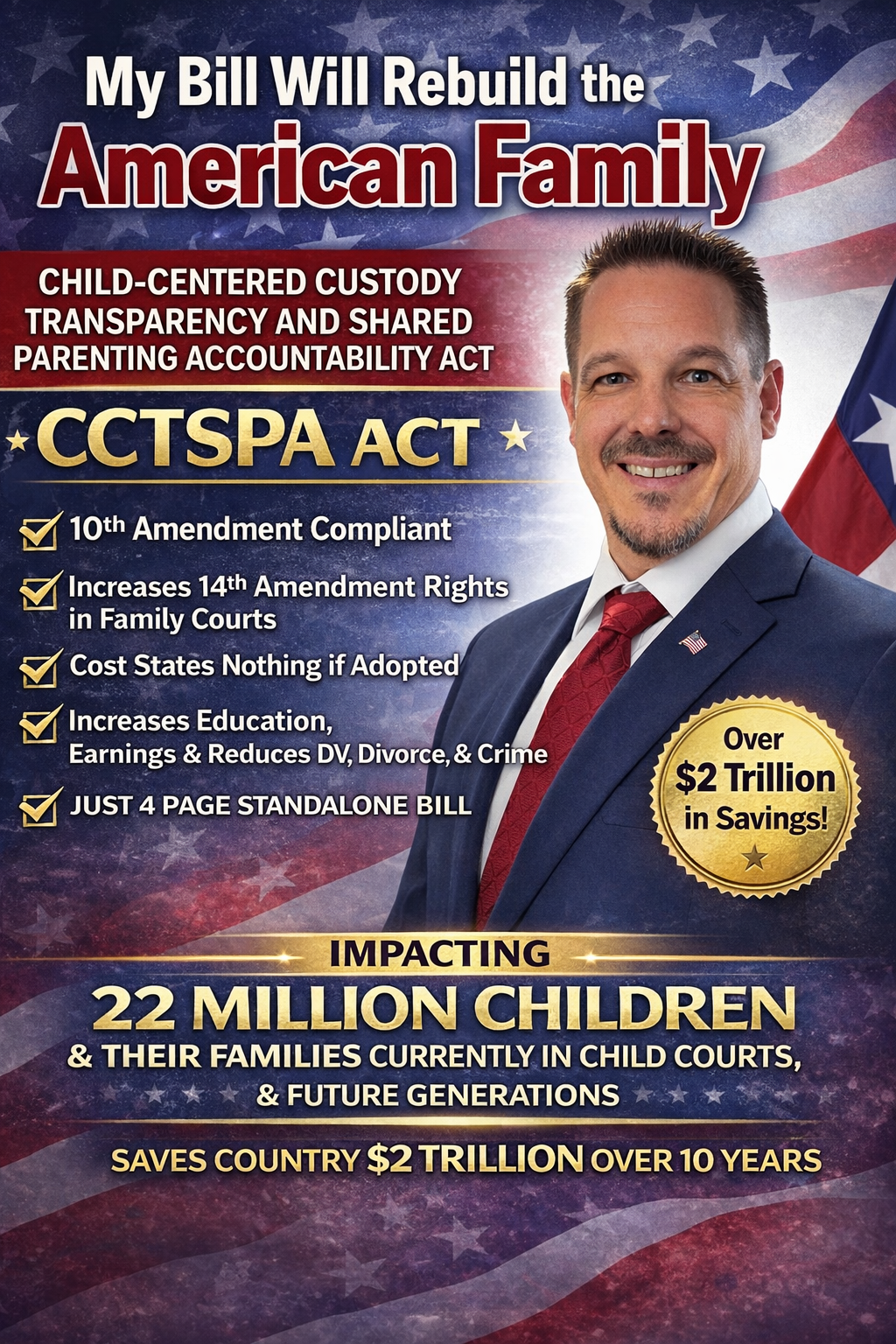
America’s family courts are failing the very people they were designed to protect — our children.
As a father who has lived through years of injustice, delays, bias, and inconsistent rulings, I know first-hand how broken the system really is. Families are drained financially. Children are used as leverage. Courts ignore evidence, silence children’s voices, and tolerate misconduct without accountability.
Enough is enough.
I'm running for Congress because no one else is willing to take on this fight. Our children deserve fairness. Parents deserve equal treatment. And the system must serve families — not destroy them.
Sign this petition if you agree it’s time for:
✔ Equal parental rights
✔ Mandatory accountability for judges and GALs
✔ Faster case timelines
✔ Real consequences for false allegations
✔ Protecting children’s voices
✔ Transparent, consistent, and fair outcomes
Add your name now. Together, we will fix this system and protect American families.
CHILD CENTERED CUSTODY TRANSPARENCY AND SHARED PARENTING ACCOUNTABILITY ACT BILL
To improve transparency, accountability, and gender-neutral decision-making in State custody proceedings through structured judicial documentation and performance-based federal funding alignment, and for other purposes.
SECTION 1. SHORT TITLE.
This Act may be cited as the "CCTSPA Act”: Child-Centered Custody Transparency and Shared Parenting Accountability Act.
SEC. 2. CONGRESSIONAL FINDINGS.
Child custody determinations materially affect long-term mental health, educational attainment, economic productivity, and social stability.
Substantial peer-reviewed research demonstrates that children benefit from meaningful involvement of both parents and that fathers are not inherently less capable caregivers.
Persistent nationwide disparities in custody outcomes therefore indicate systemic bias rather than parental incapacity.
Current custody proceedings often rely on broad subjective standards without structured documentation, limiting transparency and meaningful appellate review.
Federal child support enforcement funding under Title IV-D was created to address systemic failures that existed decades ago but does not require gender-neutral custody practices or documented judicial reasoning.
Federal spending authority may be used to incentivize transparency, accountability, and child-centered outcomes without mandating custody determinations or preempting State family law.
Long-term reductions in federal dependency are expected as children raised with balanced parental involvement demonstrate improved mental health, higher lifetime earnings, higher education levels, reduced crime, and reduced reliance on public assistance.
As shown by the State of Kentucky’s 2018 act, similar legislation showed a significant reduction in divorce rates.
The cascading positive effects of this bill are yet incalculable as it will positively change many areas of American society.
SEC. 3. PURPOSES.
To require structured documentation of custody decisions in contested cases.
To incentivize gender-neutral adjudication and promote shared parenting outcomes consistent with each State’s own laws.
To reduce litigation, conflict, and unnecessary appeals.
To improve child well-being and long-term economic outcomes.
To replace outdated federal enforcement incentives with performance-based accountability.
SEC. 4. DEFINITIONS.
Contested custody case: means any custody proceeding in which the parties do not jointly submit a complete parenting plan.
Custody Decision Data Includes: (a) Case status (Contested vs. Uncontested); (b) Resolution Type (Parental Agreement vs. Court-Ordered Determination); (c) Designation of primary parent; (d) Actual percentage of parenting time ordered; (e) Specific statutes/case law cited; (f) Presence of safety concerns each documented, and law cited if not used in the courts decision; (g) Education level of parents (statistical only).
Participating State: means any State electing to participate in this Act.
Qualified Parental Agreement: is any court-approved parenting plan jointly submitted by the parties. For funding purposes, these agreements shall be categorized by the same performance tiers as court-ordered determinations in Section 9.
Severe Child Abuse shall be defined by each Participating State based on their own applicable State laws and statutes.
SEC. 5. STRUCTURED CUSTODY FINDINGS REQUIREMENT.
As a condition of participation, each State shall require that in all contested custody cases the presiding judge issue written findings containing Custody Decision Data contemporaneously with the custody order. Nothing in this section shall alter judicial discretion or custody standards under State law.
SEC. 6. TERMINATION OF TITLE IV-D CHILD SUPPORT ENFORCEMENT FUNDING.
(a) Beginning twelve (12) months after enactment, no federal funds shall be obligated or expended to carry out Title IV-D of the Social Security Act for child support enforcement activities.
(b) Amounts that would otherwise have been made available under Title IV-D shall instead be made available under Section 7 of this Act.
SEC. 7. FAMILY COURT TRANSPARENCY AND SHARED PARENTING INCENTIVE PROGRAM.
(a) The Secretary of Health and Human Services shall establish a voluntary program providing payments to States that comply with this Act.
(b) States declining participation shall receive no replacement funds.
(c) Eligibility requires certification of: (1) Structured custody documentation under Section 5; (2) Policies prohibiting preferential treatment of either parent based on sex; (3) Annual reporting of contested custody outcomes.
SEC. 8. ALLOCATION AND CENSUS-BASED DISTRIBUTION.
(a) Fair Division: Total federal funding for payouts shall be divided among Participating States based on U.S. Census Bureau population data, ensuring funding is proportional to the size of the State rather than the number of active court cases.
(b) Performance Allocation:
1. The Agreement Track: The 75% payout shall only apply to Qualified Parental Agreements. Any agreement falling outside the 45/55 range shall be processed under the Adjudication Track (State Averages) to ensure it does not artificially inflate state performance metrics by reflecting the reduced burden on courts and improved long-term outcomes associated with cooperative parenting agreements.
2. The Adjudication Track: For all cases ending in a court-ordered determination (where parents did not agree), the remaining funding shall be distributed based on the State Average performance against the Unified Performance Scale in Section 9.
Forty percent (40%) based on progress toward gender-neutral primary custody outcomes.
Forty percent (40%) based on progress toward equal parenting time.
Twenty percent (20%) for court audit personnel, compliance reporting systems, and appellate enforcement incentives.
(c) The Efficiency Dividend: Once a Participating State achieves a sustained metric of 55/45 gender-neutral primary custody and 55/45 equal parenting time, the allocation for District Court Administration (DCA) and audit personnel shall be reduced to ten percent (10%), as the workload associated with high-conflict litigation is reduced. The remaining ten percent (10%) shall be returned to the Federal Treasury to reduce federal spending.
SEC. 9. UNIFIED PERFORMANCE SCALE AND RAMP-UP PERIOD.
(a) SEC. 9(a) UNIFIED PERFORMANCE SCALE (STATE AVERAGES).
Funding for the Adjudication Track shall be determined by the annual statewide average of court-ordered custody outcomes.
Calculation: The average is calculated by totaling the awarded parenting time for the secondary parent across all court-ordered (non-agreement) cases and dividing by the total number of such cases.
Target: To receive the maximum 100% payout for the Adjudication Track, the Participating State must achieve a statewide average of 45% to 55% parenting time for both genders by Year Five.
(b) Progression Ramp-Up Period: To allow for administrative transition and judicial training, a Participating State shall receive maximum funding provided they meet the following minimum annual progression benchmarks for gender-neutrality and parenting time:
Year One: Minimum 80/20 state average outcomes.
Year Two: Minimum 70/30 state average outcomes.
Year Three: Minimum 60/40 state average outcomes.
Year Four: Minimum 50/50 or 45/55 state average outcomes
Year Five and Beyond: Sustained 50/50 or 45/55 state average outcomes
(b) Standard Scale: Following the ramp-up period:
State average Outcomes of forty-five percent (45%) or greater shall receive maximum payout.
State average Outcomes 60/40 or greater shall receive partial funding of 66%.
State average Outcomes 70/30 or greater disparity shall receive reduced funding of 33%.
State average Outcomes any less than 70/30 will receive no funding.
SEC. 10. AUDIT AND APPELLATE ENFORCEMENT.
Participating States shall establish court audit personnel reporting to Chief Judges. Compliance reports shall be transmitted to appellate courts for a total of 10%. Appellate courts may receive incentive funding for remands or reversals where lower courts fail to meet documentation standards up to 10%.
SEC. 11. EXCLUSION OF SEVERE CHILD ABUSE CASES.
(a) Custody cases involving substantiated Severe Child Abuse (as defined by State law) requiring sole custody shall be excluded from performance calculations.
(b) In any such excluded case, the presiding judge shall issue written findings identifying:
(1) The specific statutory basis under State law supporting sole custody; (2) The evidentiary record relied upon; and (3) The factual findings establishing severe abuse.
(c) Allegations alone shall not qualify a case for exclusion. Only judicial findings supported by evidence and entered into the record may trigger exclusion.
(d) The states judicial branch shall audit all abuse finding on appeal to determine whether the state severe child abuse case standard is met.
SEC. 12. EXCLUSION OF UNCONTESED CASES.
(a) Custody cases involving an uncontested nature requiring sole custody shall be excluded from performance calculations.
SEC. 13. STANDALONE ENACTMENT AND ANTI-COMMINGLING MANDATE.
(a) INDEPENDENT CONSIDERATION: In recognition of the profound national impact of this Act, it is the directive of Congress that this measure be considered, debated, and voted upon strictly as a standalone bill.
(b) PROHIBITION OF ATTACHMENTS: No unrelated legislative provisions, riders, or amendments—whether financial, policy-based, or otherwise—shall be appended to this Act during any stage of the legislative process
(c) OMNIBUS EXCLUSION AND SEVERABILITY.: This Act shall not be incorporated into any omnibus spending bill, multi-subject legislative package, or continuing resolution. Should any portion of this Act be incorporated into a broader legislative vehicle, such incorporation shall be considered a violation of the Statutory Intent, and this Act shall be extracted and restored to its status as an independent measure for a direct, recorded up-or-down vote.
SEC. 14. STATE AUTONOMY PRESERVED.
Nothing in this Act shall: (1) Mandate custody outcomes; (2) Preempt State family law; (3) Alter parental rights; (4) Limit judicial discretion.
SEC. 15. EFFECTIVE DATE.
This Act shall take effect twelve (12) months after enactment.
Sponsor: Keith Barton, CD-23 Texas.