The “AMERICAN LEAN ACT”
Full Transparency is what Government requires, therefore below are the Drafts of each Bill as part of the American Lean Act
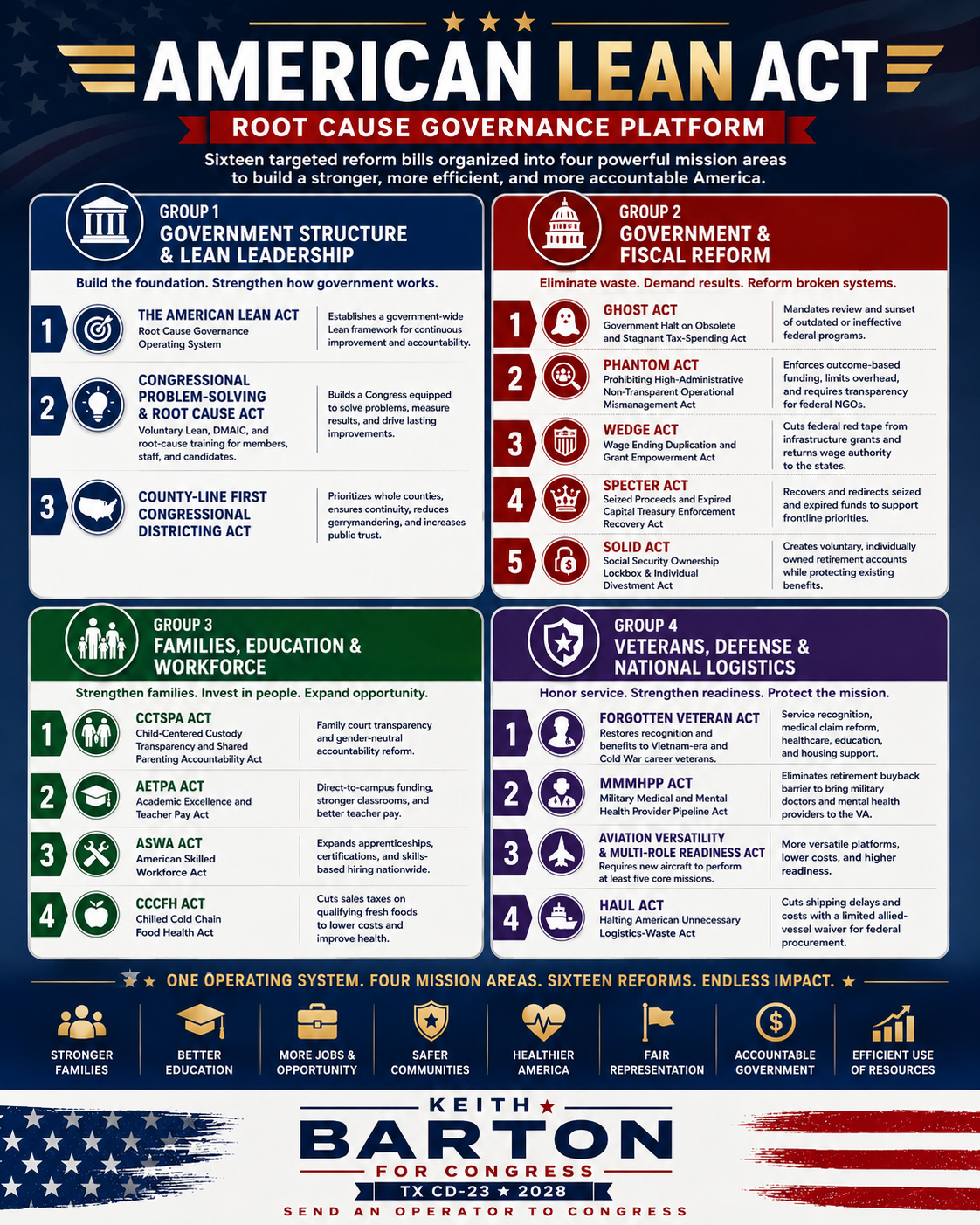
THE AMERICAN LEAN ACT
AN ACT
To establish an operational turnaround framework for the federal government; to mandate root-cause analysis in the legislative process; to optimize administrative overhead; to institutionalize Lean management and DMAIC practices within Congressional operations; and to preserve essential front-line services through structural optimization without increasing the national tax burden.
CONSTITUTIONAL AUTHORITY STATEMENT
Congress enacts this Act pursuant to its authority under Article I, Section 8, Clause 1 (The Power to Tax and Spend for the General Welfare), Clause 3 (The Commerce Clause), and Clause 18 (The Necessary and Proper Clause) of the United States Constitution.
PART I: THE CORPORATE TURNAROUND CHARTER
SECTION 1. SHORT TITLE.
This Act may be cited as the "American Lean Act".
SECTION 2. FINDINGS AND PURPOSE.
(a) Findings.—Congress finds the following:
The federal government operates with systemic inefficiencies, frequently allocating taxpayer capital to fund the superficial symptoms of societal problems rather than isolating and resolving their root causes.
Traditional legislative packages are excessively lengthy, intentionally complex, and designed to obscure waste, preventing transparent auditing and accountable governance.
Bureaucratic administrative bloat absorbs critical resources before they reach front-line citizens, first responders, military personnel, and working families.
Private-sector organizations successfully utilize Lean manufacturing principles and the DMAIC (Define, Measure, Analyze, Improve, Control) framework to eliminate waste, standardize quality, and optimize delivery without increasing base costs.
(b) Purpose.—The purpose of this Act is to establish a permanent, annual change-management structure across the legislative branch. This Act serves as a rolling mechanism to demonstrate that targeted, short-format, modular legislation can systematically dismantle administrative friction and maximize downstream fiscal savings.
SECTION 3. THE MANDATORY LEGISLATIVE BINDING RULES (THE GUARDRAILS).
Every Title, Section, individual Module, and provision submitted for consideration under this Act must conform strictly to the following five self-imposed operational constraints:
The Brevity and Target Mandate.—Each provision must be short, written in plain language, and targeted exclusively at an isolated root cause. It shall not address secondary or tertiary symptoms.
The Fiscal Cap.—No provision within this Act shall increase the federal tax burden, create new tax brackets, or authorize new federal appropriations. Operational implementation costs are strictly limited to existing internal Washington agency man-hours.
The Service Shield.—Arbitrary or blind horizontal budget cuts to essential citizen-facing services are strictly prohibited. Reductions must be achieved solely by bypassing, consolidating, or eliminating redundant administrative management layers.
The Metrics and Feedback Loop.—No program or process may be altered under this Act without the concurrent implementation of a live, public-facing digital dashboard to audit performance metrics and enforce an ongoing operational control loop.
The Modular Expansion Authority.—Independent, specialized Titles and Modules may be appended to this Act during its annual legislative cycle, provided such additions remain in absolute compliance with all mandatory operational constraints established under this Section.
PART II: THE ANNUAL MODULAR ROADMAP
SECTION 4. THE CONFLICT-FREE ANNUAL SUBMISSION RULES.
(a) Initial Proof-of-Concept Package.—Notwithstanding the annual sponsorship limitation established under subsection (b), the initial legislative package introduced concurrently with the establishment of the American Lean Act may contain multiple qualifying Modules sponsored by a single Member of Congress. This initial package shall serve as the proof of concept for the modular legislative framework established by this Act and shall not establish a precedent permitting multiple newly proposed Modules by a single Member during subsequent Annual Modular Cycles.
(b) The Annual Modular Cycle.—Congress shall host an Annual Session Cycle for the American Lean Act. Beginning with the first Annual Modular Cycle following the initial proof-of-concept package, every individual Member of the House of Representatives and the United States Senate is authorized to serve as the primary sponsor of not more than one (1) newly proposed specialized legislative Module for inclusion in that year's annual package.
(c) Unlimited Co-Sponsorship.—The limitation established under subsection (b) applies only to the primary sponsorship of newly proposed Modules. A Member may co-sponsor an unlimited number of qualifying Modules introduced by other Members during an Annual Modular Cycle.
(d) Reintroduction and Continuous Improvement of Existing Modules.—The limitation established under subsection (b) shall not apply to a Module previously sponsored by that Member. A Member may reintroduce, sponsor, or submit without numerical limitation any previously sponsored Module when the purpose of such reintroduction is to amend, improve, correct, expand, streamline, or otherwise modify the Module based upon measurable performance data, operational findings, or identified deficiencies documented through the American Lean Dashboard or another control mechanism established under the applicable Module. Such reintroduction shall not consume the Member's one-new-Module allowance for that Annual Modular Cycle.
(e) The Training Prerequisite Mandate.—To ensure maximum baseline competency and data-driven integrity in legislative drafting, no Member of Congress may sponsor, co-sponsor, or submit a Module for consideration under this Act unless that Member, alongside their designated competency staff, is fully certified and current on their voluntary training under the Congressional Problem-Solving and Root Cause Accountability Act. The Congressional Competency Dashboard shall serve as the final legal verification mechanism for eligibility.
(f) Pre-Submission Guardrail Certification.—Prior to floor introduction, any submitted module must be electronically analyzed and certified by the Committee on Oversight and Accountability to ensure absolute compliance with the five mandatory guardrails of Section 3. Non-compliant submissions are barred from the floor.
SECTION 5. HIGH-VELOCITY WORKFLOW COORDINATION.
(a) Independent Module Consideration.—Each individual Module appended to the Annual Lean Act shall remain independently debatable and amendable.
(b) The Rapid-Fire Floor Cadence.—To prevent legislative stagnation, all certified and compliant Modules submitted during the annual cycle must be subjected to an expedited, rapid-fire floor vote. The failure, tabling, or rejection of any single Module shall not delay, invalidate, or otherwise affect the high-velocity consideration of remaining Modules within the Act.
(c) Workflow Leadership.—The Committee on Oversight and Accountability of the House of Representatives shall serve as the coordinating body for workflow assignment, rapid-fire scheduling cadence, and the rolling procedural management of Modules appended under this Act.
CHILD CENTERED CUSTODY TRANSPARENCY AND SHARED PARENTING ACCOUNTABILITY ACT BILL
To improve transparency, accountability, and gender-neutral decision-making in State custody proceedings through structured judicial documentation and performance-based federal funding alignment, and for other purposes.
SECTION 1. SHORT TITLE.
This Act may be cited as the "CCTSPA Act”: Child-Centered Custody Transparency and Shared Parenting Accountability Act.
SEC. 2. CONGRESSIONAL FINDINGS.
Child custody determinations materially affect long-term mental health, educational attainment, economic productivity, and social stability.
Substantial peer-reviewed research demonstrates that children benefit from meaningful involvement of both parents and that fathers are not inherently less capable caregivers.
Persistent nationwide disparities in custody outcomes therefore indicate systemic bias rather than parental incapacity.
Current custody proceedings often rely on broad subjective standards without structured documentation, limiting transparency and meaningful appellate review.
Federal child support enforcement funding under Title IV-D was created to address systemic failures that existed decades ago but does not require gender-neutral custody practices or documented judicial reasoning.
Federal spending authority may be used to incentivize transparency, accountability, and child-centered outcomes without mandating custody determinations or preempting State family law.
Long-term reductions in federal dependency are expected as children raised with balanced parental involvement demonstrate improved mental health, higher lifetime earnings, higher education levels, reduced crime, and reduced reliance on public assistance.
As shown by the State of Kentucky’s 2018 act, similar legislation showed a significant reduction in divorce rates.
The cascading positive effects of this bill are yet incalculable as it will positively change many areas of American society.
SEC. 3. PURPOSES.
To require structured documentation of custody decisions in contested cases.
To incentivize gender-neutral adjudication and promote shared parenting outcomes consistent with each State’s own laws.
To reduce litigation, conflict, and unnecessary appeals.
To improve child well-being and long-term economic outcomes.
To replace outdated federal enforcement incentives with performance-based accountability.
SEC. 4. DEFINITIONS.
Contested custody case: means any custody proceeding in which the parties do not jointly submit a complete parenting plan.
Custody Decision Data Includes: (a) Case status (Contested vs. Uncontested); (b) Resolution Type (Parental Agreement vs. Court-Ordered Determination); (c) Designation of primary parent; (d) Actual percentage of parenting time ordered; (e) Specific statutes/case law cited; (f) Presence of safety concerns each documented, and law cited if not used in the courts decision; (g) Education level of parents (statistical only).
Participating State: means any State electing to participate in this Act.
Qualified Parental Agreement: is any court-approved parenting plan jointly submitted by the parties. For funding purposes, these agreements shall be categorized by the same performance tiers as court-ordered determinations in Section 9.
Severe Child Abuse shall be defined by each Participating State based on their own applicable State laws and statutes.
SEC. 5. STRUCTURED CUSTODY FINDINGS REQUIREMENT.
As a condition of participation, each State shall require that in all contested custody cases the presiding judge issue written findings containing Custody Decision Data contemporaneously with the custody order. Nothing in this section shall alter judicial discretion or custody standards under State law.
SEC. 6. TERMINATION OF TITLE IV-D CHILD SUPPORT ENFORCEMENT FUNDING.
(a) Beginning twelve (12) months after enactment, no federal funds shall be obligated or expended to carry out Title IV-D of the Social Security Act for child support enforcement activities.
(b) Amounts that would otherwise have been made available under Title IV-D shall instead be made available under Section 7 of this Act.
SEC. 7. FAMILY COURT TRANSPARENCY AND SHARED PARENTING INCENTIVE PROGRAM.
(a) The Secretary of Health and Human Services shall establish a voluntary program providing payments to States that comply with this Act.
(b) States declining participation shall receive no replacement funds.
(c) Eligibility requires certification of: (1) Structured custody documentation under Section 5; (2) Policies prohibiting preferential treatment of either parent based on sex; (3) Annual reporting of contested custody outcomes.
SEC. 8. ALLOCATION AND CENSUS-BASED DISTRIBUTION.
(a) Fair Division: Total federal funding for payouts shall be divided among Participating States based on U.S. Census Bureau population data, ensuring funding is proportional to the size of the State rather than the number of active court cases.
(b) Performance Allocation:
1. The Agreement Track: The 75% payout shall only apply to Qualified Parental Agreements. Any agreement falling outside the 45/55 range shall be processed under the Adjudication Track (State Averages) to ensure it does not artificially inflate state performance metrics by reflecting the reduced burden on courts and improved long-term outcomes associated with cooperative parenting agreements.
2. The Adjudication Track: For all cases ending in a court-ordered determination (where parents did not agree), the remaining funding shall be distributed based on the State Average performance against the Unified Performance Scale in Section 9.
Forty percent (40%) based on progress toward gender-neutral primary custody outcomes.
Forty percent (40%) based on progress toward equal parenting time.
Twenty percent (20%) for court audit personnel, compliance reporting systems, and appellate enforcement incentives.
(c) The Efficiency Dividend: Once a Participating State achieves a sustained metric of 55/45 gender-neutral primary custody and 55/45 equal parenting time, the allocation for District Court Administration (DCA) and audit personnel shall be reduced to ten percent (10%), as the workload associated with high-conflict litigation is reduced. The remaining ten percent (10%) shall be returned to the Federal Treasury to reduce federal spending.
SEC. 9. UNIFIED PERFORMANCE SCALE AND RAMP-UP PERIOD.
(a) SEC. 9(a) UNIFIED PERFORMANCE SCALE (STATE AVERAGES).
Funding for the Adjudication Track shall be determined by the annual statewide average of court-ordered custody outcomes.
Calculation: The average is calculated by totaling the awarded parenting time for the secondary parent across all court-ordered (non-agreement) cases and dividing by the total number of such cases.
Target: To receive the maximum 100% payout for the Adjudication Track, the Participating State must achieve a statewide average of 45% to 55% parenting time for both genders by Year Five.
(b) Progression Ramp-Up Period: To allow for administrative transition and judicial training, a Participating State shall receive maximum funding provided they meet the following minimum annual progression benchmarks for gender-neutrality and parenting time:
Year One: Minimum 80/20 state average outcomes.
Year Two: Minimum 70/30 state average outcomes.
Year Three: Minimum 60/40 state average outcomes.
Year Four: Minimum 50/50 or 45/55 state average outcomes
Year Five and Beyond: Sustained 50/50 or 45/55 state average outcomes
(b) Standard Scale: Following the ramp-up period:
State average Outcomes of forty-five percent (45%) or greater shall receive maximum payout.
State average Outcomes 60/40 or greater shall receive partial funding of 66%.
State average Outcomes 70/30 or greater disparity shall receive reduced funding of 33%.
State average Outcomes any less than 70/30 will receive no funding.
SEC. 10. AUDIT AND APPELLATE ENFORCEMENT.
Participating States shall establish court audit personnel reporting to Chief Judges. Compliance reports shall be transmitted to appellate courts for a total of 10%. Appellate courts may receive incentive funding for remands or reversals where lower courts fail to meet documentation standards up to 10%.
SEC. 11. EXCLUSION OF SEVERE CHILD ABUSE CASES.
(a) Custody cases involving substantiated Severe Child Abuse (as defined by State law) requiring sole custody shall be excluded from performance calculations.
(b) In any such excluded case, the presiding judge shall issue written findings identifying:
(1) The specific statutory basis under State law supporting sole custody; (2) The evidentiary record relied upon; and (3) The factual findings establishing severe abuse.
(c) Allegations alone shall not qualify a case for exclusion. Only judicial findings supported by evidence and entered into the record may trigger exclusion.
(d) The states judicial branch shall audit all abuse finding on appeal to determine whether the state severe child abuse case standard is met.
SEC. 12. EXCLUSION OF UNCONTESED CASES.
(a) Custody cases involving an uncontested nature requiring sole custody shall be excluded from performance calculations.
SEC. 13. INDEPENDENT CONSIDERATION AND ANTI-COMMINGLING MANDATE.
(a) PERMITTED LEGISLATIVE VEHICLES: In recognition of the profound national impact of this Act, this measure may be introduced, considered, debated, and voted upon either as a standalone bill or as an individual Module of the American Lean Act. When considered as a Module of the American Lean Act, this Act shall remain independently debatable, amendable, and votable in accordance with the requirements of the American Lean Act.
(b) PROHIBITION OF ATTACHMENTS: No unrelated legislative provisions, riders, or amendments, whether financial, policy-based, or otherwise, shall be appended to this Act during any stage of the legislative process.
(c) OMNIBUS EXCLUSION AND SEVERABILITY: Except for inclusion as an individual Module of the American Lean Act, this Act shall not be incorporated into any omnibus spending bill, multi-subject legislative package, or continuing resolution. Should any portion of this Act be incorporated into a broader legislative vehicle other than the American Lean Act, such incorporation shall be considered a violation of the Statutory Intent, and this Act shall be extracted and restored to its status as either an individual Module of the American Lean Act or an independent measure for a direct, recorded up-or-down vote.
SEC. 14. STATE AUTONOMY PRESERVED.
Nothing in this Act shall: (1) Mandate custody outcomes; (2) Preempt State family law; (3) Alter parental rights; (4) Limit judicial discretion.
SEC. 15. EFFECTIVE DATE.
This Act shall take effect twelve (12) months after enactment.
Sponsor: Keith Barton, CD-23 Texas.
ACADEMIC EXCELLENCE AND TEACHER PAY ACT
AN ACT
To amend the Every Student Succeeds Act and the Department of Education Organization Act to eliminate administrative process waste, establish structural funding controls, and optimize core student achievement.
Be it enacted by the Senate and House of Representatives of the United States of America in Congress assembled,
SECTION 1. SHORT TITLE.
This Act may be cited as the "AETPA".
SECTION 2. DEFINE PHASE: SYSTEM IDENTIFICATION AND RE-ORDERING.
(a) STATEMENT OF STRUCTURAL DEFECTS.—Congress finds administrative layers that do not directly contribute to measurable classroom instructional outcomes—
(1) wherein substantial portions of educational expenditures are consumed by state and district-level administrative overhead before reaching classroom instructional functions;
(2) early overreliance on digital learning devices in foundational childhood education may negatively affect attention development, handwriting proficiency, reading retention, and classroom engagement; and
(3) the expansion of non-core elective coursework that does not consistently demonstrate measurable contributions to literacy, STEM readiness, workforce preparedness, or long-term educational outcomes.
(b) CORE PURPOSE.— The operational objective of this Act is to restructure the federal K-12 funding distribution process into a direct-to-campus allocation model designed to maximize classroom instructional funding efficiency and improve equitable student resource access across all economic backgrounds.
SECTION 3. MEASURE PHASE: ESTABLISHING THE VALUE STREAM AND RECIPIENT NODE.
(a) ELIMINATION OF DISTRICT INTERCEPTION.—Notwithstanding any other provision of law, the federal government shall calculate formula grant allocations, including Title I and IDEA allocations, based strictly on the raw student registration roster per individual school campus utilizing National Center for Education Statistics (NCES) campus identification codes.
(b) STATE PASS-THROUGH MANDATE.—
(1) PROCESSING NODE DESIGNATION.—The State Education Agency (SEA) of each state shall function exclusively as an administrative processing node and check-issuer for funds distributed under this Act.
(2) TOTAL CAP ON ADMIN SKIM.— A state receiving federal K-12 formula grants may not withhold, reallocate, or divert any portion of the campus allocation for state-level or district-level administrative expenditures. The state shall distribute 100 percent of the calculated campus allocation directly to the respective school campus operational account within 30 days of federal receipt.
(3) SEPARATE OPERATIONAL FINANCING.—If a state or local school board elects to maintain non-instructional administrative personnel, compliance managers, or non-instructional consulting or administrative personnel, such overhead must be funded entirely out of state or local tax revenues.
SECTION 4. ANALYZE PHASE: THE 75% INSTRUCTIONAL VAULT BOUNDARY AND DEFECT TRACING.
(a) THE VAULT CONSTRAINT.—A school principal receiving federal direct-to-principal dollars shall deposit 100 percent of such funds into a dedicated campus escrow account, which must be spent exclusively on direct instructional costs.
(b) INSTRUCTIONAL COST LIMITATIONS.— Direct instructional costs are restricted strictly to—
(1) classroom teacher salaries and performance-based merit compensation;
(2) physical textbooks, paper, and analog manual writing supplies; and
(3) classroom material inputs for core subjects and designated data-backed cognitive electives.
(c) DEFINE VALUE-ADD CLASSROOM OUTPUTS.—
(1) CORE SUBJECTS.—The core foundations are defined as Math, Science, English, and History.
(2) AUTHORIZED INSTRUCTIONAL EXCEPTIONS.— The following instructional categories are authorized under the instructional funding constraint based on demonstrated educational, cognitive, workforce, or long-term student development outcomes, including;
(A) High-Value Arts: Instrumental and vocal performance music (band and choir);
(B) Cognitive Systems: Standalone world language lines;
(C) Strategic reasoning and applied logic programs focused on pattern recognition, spatial analysis, and long-range problem solving;
(D) Trade Engineering: Hands-on vocational trade labs and home economics; and
(E) The Financial Ledger: Mandatory, standalone personal financial literacy.
(d) INFRASTRUCTURE AND OVERHEAD BAN.— No portion of the campus instructional allocation account may be expended on district-level administrative facilities, non-instructional executive compensation, or non-classroom capital infrastructure projects.
(e) AMERICANS WITH DISABILITIES ACT AND SPECIAL EDUCATION SAFE HARBOR.—
(1) STATUTORY EXCLUSION.—The structural constraints, instructional cost limitations, and infrastructure bans established under this Section shall not apply to any expenditure explicitly required to satisfy a student's Individualized Education Program (IEP) under the Individuals with Disabilities Education Act (20 U.S.C. § 1400 et seq.) or reasonable accommodations mandated under Title II of the Americans with Disabilities Act of 1990 (42 U.S.C. § 12131 et seq.).
(2) PERMISSIBLE ACCOMMODATION EXPENSES.—A school principal may utilize the campus escrow account to purchase specialized assistive technology, adaptive learning software, tactile instructional materials, or localized classroom physical modifications, provided such expenses are documented as a direct legal accommodation for students with verified disabilities.
SECTION 5. IMPROVE PHASE: DISMANTLING DEVICE BLOWOUTS AND SYNTAX REALIGNMENT.
(a) THE K-3 SCREEN-FREE instructional allocation requirement.— To support foundational literacy, handwriting development, and early classroom engagement, no federal grant funds distributed under this Act may be used to procure or deploy individually assigned digital tablets or laptops for students in Kindergarten through Third Grade. Elementary literacy and mathematics instruction must be executed exclusively via analog paper, print books, and manual handwriting.
(b) SYNTAX AS A REPLACEMENT LANGUAGE ELECTIVE.—
(1) TECHNICAL SUBSTITUTION LEVER.—In Grades 9 through 12, school campuses shall allow students to fulfill their graduation foreign language requirement by substituting a rigorous course in text-based computer programming languages.
(2) OBJECT-ORIENTED CODING CONSTRAINT.—To qualify for language funding under the instructional allocation requirement, computer science tracks must consist entirely of text-based, object-oriented syntax (Python, C++, or Java) written line-by-line. Federal instructional funding under this Act may not be used for non-text-based introductory coding platforms or non-technical software familiarity coursework. Keyboarding and touch-typing mechanics must be integrated directly into English and Language text composition classes rather than separate, isolated screen filler tracks.
SECTION 6. CONTROL PHASE: THE ANNUAL ACCURACY AUDIT AND ZERO-BASELINE LOCKS.
(a) TIMELINE MAINTENANCE OF EFFORT (MOE).—
(1) HISTORICAL BASE-PAY FLOOR.—To maintain eligibility for federal K-12 formula funding, a state and its local school districts must maintain their total state and local instructional expenditure per student at a level equal to or greater than the preceding fiscal year.
(2) NON-SUPPLANTATION PROHIBITION.—Federal direct-to-principal funds shall function strictly as an additive booster to supplement, not supplant, state and local instructional dollars. If a state lowers its base teacher salary scales or cuts local classroom supply budgets, the federal government shall automatically freeze 100 percent of that state's federal education funding pipeline.
(b) THE BINARY COMPLIANCE POST-AUDIT.—
(1) STATE REPORTING TRACK.—The state shall perform a streamlined, retroactive annual post-audit of each campus escrow account to verify compliance with the 75% Instructional Vault boundary.
(2) DEFECT REMEDIATION.— “If a principal fails the compliance audit by allocating federal funds toward unauthorized administrative expenditures or non-approved instructional categories, the state shall report the violation to the U.S. Treasury, and the campus's next federal allocation shall automatically be placed on an administrative hold until the process error is fully remediated.
(c) ZERO-BASELINE FORECAST PROTECTION.— Because expenditure recovery and funding realignment outcomes may vary annually, all funds redirected through this Act shall be applied exclusively toward active instructional operations, teacher compensation enhancements, or current-term educational expenditure, prohibiting any speculative future budgeting by local school boards.
A Bill
Title 40 Amendment for First Responder Equipment Savings
SEC. 801. SHORT TITLE.
This Title may be cited as the "Title 40 FRES (First Responder and Enforcement Savings) Amendment" (40 U.S.C. 502) (p. 1).
SEC. 802. PURPOSE AND FINDINGS.
(a) PURPOSE.—The explicit purpose of this Act is to systematically reduce local municipal, state, and federal public safety operational and equipment procurement costs by leveraging national volume-buying scales (p. 1). This maximizes fiscal availability for local jurisdictions and federal agencies to permanently increase the base compensation, hazardous duty incentives, and retention levels of active-duty, shift-working law enforcement officers, border patrol agents, and career firefighters without increasing tax burdens or creating new federal appropriations (p. 1).
(b) FINDINGS.—Congress finds that hyper-inflation and bloated, non-standard custom procurement contracts in public safety and national security domains systematically drain tax revenues (p. 1). This creates a processing defect that directly restricts the financial capacity of jurisdictions and federal sectors to fund competitive salaries and critical infrastructure for front-line first responders and border enforcement personnel (p. 1).
(c) RECOMMENDATION.—While the federal government cannot dictate local municipal first responder salary increases, this amendment is enacted for the sole purpose of assisting states, counties, cities, and federal border sectors in that effort (p. 1).
SEC. 803. DIRECT LOCAL PROCUREMENT AND GSA ALIGNMENT WITH STRICTEST STATE LAWS.
Section 502 of title 40, United States Code, is amended by adding at the end the following new subsection:
(f) DIRECT LOCAL PROCUREMENT OF PUBLIC SAFETY EQUIPMENT.—
(1) DIRECT ACCESS MANDATE.—The Administrator of General Services shall grant direct digital procurement access to the Federal Supply Schedules (Schedule 84) to any certified municipal, county, or tribal public safety agency for the purchase of non-weapon individual law enforcement and firefighting safety equipment (p. 1). Access shall be granted directly to local agencies, notwithstanding any state point of contact (SPOC) requirement established under the 1122 Program (p. 1).
(2) AUTOMATED PORTAL COMPLIANCE AND DEREGULATION TIERS.—
(a) THE $5,000 MICRO-PURCHASE SAFE HARBOR.—Any procurement transaction executed through the GSA public safety schedules under this Act where the aggregate order amount does not exceed $5,000 shall be legally classified as a local micro-purchase.
(b) COMPLETE STATE LAW PREEMPTION.—Pursuant to the Supremacy Clause of Article VI of the United States Constitution, any local micro-purchase under this section is completely exempt from all state, county, or municipal sealed-bidding thresholds, advertising laws, or public notice mandates. State laws demanding manual competitive processes at any threshold are hereby rendered null and void for these transactions.
(c) THE AUTOMATED THREE-QUOTE ACCELERATOR.—For any purchase exceeding $5,000, the digital interface shall require the purchasing agent to natively select from a minimum of three digital quotes generated inside the GSA portal (p. 2). The generation and electronic logging of these three native schedule quotes through the American Lean Dashboard shall legally constitute full, open, and final competitive bidding for all auditing purposes (p. 2), completely shielding the local jurisdiction from any state-level civil liability or administrative penalty.
(d) OPERATIONS VELOCITY.—The automated match protocol must complete the competitive quote-comparison lifecycle within the digital checkout environment in less than five minutes, completely bypassing manual public notice windows, advertising delays, or administrative evaluation boards.
SEC. 804. THE PAYROLL VAULT AND FRONTLINE RETENTION MANDATE.
As a condition of utilizing the cooperative purchasing schedules under section 803 of this Act, or executing procurement operations under section 806 of this Act, a purchasing jurisdiction or federal sector must comply with the following structural constraints (p. 2):
(a) QUANTIFIED COST VARIANCE.—The purchasing entity shall generate and submit a certified Procurement Value Report via the public-facing American Lean Dashboard (p. 2).
(b) AUTOMATED SEQUESTRATION.—The exact, quantified dollar variance between the pre-negotiated GSA schedule bulk price and the verified standard commercial retail or custom contract benchmark shall be legally sequestered into a restricted, localized escrow account (p. 2).
(c) MANDATORY APPLICATION.—Funds sequestered under this section shall be utilized exclusively to fund direct base compensation increases, hazardous duty pay adjustments, retention bonuses, or localized frontline infrastructure (including remote housing) for active-duty, shift-working personnel within that specific jurisdiction or border sector.
SEC. 805. STATE RECONCILIATION AND PETITION MECHANISM.
(a) PETITION PROCESS.—Any State whose internal procurement statutes or administrative rules prevent local political subdivisions from utilizing the GSA public safety schedules under this Act may submit a formal Process Variance Petition to the Administrator of General Services (p. 2). The petition must explicitly detail the specific state statutory requirement that the current GSA procurement process fails to satisfy (p. 2).
(b) GSA REVIEW TIMELINE.—The Administrator of General Services shall review the petition and issue a final, binding determination within 60 business days of receipt (p. 2). The GSA shall adjust its procurement process for that category of equipment only if the modification does not compromise federal acquisition transparency, increase administrative costs, or violate the Federal Acquisition Regulation (FAR) (p. 2).
(c) PUBLIC LEDGER OF SYSTEM VARIANCE.—The GSA shall maintain a live, public-facing digital map on the American Lean Dashboard detailing (p. 2):
(1) Which states and federal border sectors are currently fully compatible and actively saving funds (p. 2).
(2) Which entities have pending or denied petitions (p. 2).
(3) The estimated total dollar amount in lost equipment savings, missed first-responder pay increases, and missed border agent retention funding for any entity that remains non-compatible (p. 2).
SEC. 806. FRONT-LINE BORDER ACQUISITION DE-EXPEDITING AND LOGISTICAL TRANSPARENCY.
(a) MANDATORY FEDERAL SUPPLY SCHEDULE USE.—Notwithstanding any emergency or independent acquisition authority granted under Title 6 or Title 14, United States Code, the Commissioner of U.S. Customs and Border Protection (CBP) shall utilize the Federal Supply Schedules (Schedule 84) for all purchases of non-weapon tactical, sensory, aerial surveillance, and individual field equipment under $25,000,000, unless the Administrator of General Services certifies that an equivalent commercial capability does not exist on the schedule.
(b) ELIMINATION OF PRIMARY CONTRACTOR MUDA.—CBP is prohibited from executing independent, cost-plus custom development contracts with third-party systems integrators for commercial-off-the-shelf (COTS) technology, including Unmanned Aerial Systems (UAS), thermal imaging optics, and ground sensors, when comparable assets are available for direct digital procurement via GSA Advantage.
(c) SECTOR INVENTORY RECONCILIATION.—All CBP equipment purchased under this section must be logged on the public-facing American Lean Dashboard. Prior to executing any new equipment purchase order, a sector chief must run an automated query of the dashboard to ensure identical, un-deployed inventory does not sit idle in a neighboring border sector's supply depot.
CHILLED COLD CHAIN FOOD HEALTH ACT
A BILL
SECTION 1. SHORT TITLE.
This Act may be cited as the "Chilled Cold Chain Food Health (CCCFH) Act".
SEC. 2. CONGRESSIONAL FINDINGS.
Congress finds the following:
The Behavioral Defect: Current state and local sales tax structures artificial inflate the register cost of raw, nutrient-dense foods, creating a financial disincentive for home cooking and driving consumer demand toward highly processed foods.
The Economic Burden: The consumption of highly processed foods accelerates systemic chronic diseases, placing a multi-billion-dollar cascading burden on federal and state healthcare cost centers, including Medicaid, Medicare, and the VA.
The Logistics Baseline: Standardizing tax exemptions based on established logistical temperature boundaries targets relief directly to fresh, unprocessed ingredients without creating new administrative tracking burdens.
SEC. 3. CONDITIONAL ADAPTATION OF STATE NUTRITION MATCHING GRANTS.
Section 16 of the Food and Nutrition Act of 2008 (7 U.S.C. 2025) is amended by adding at the end the following new subsection:
“(l) COMPLIANCE WITH CHILLED COLD CHAIN TAX EXEMPTIONS.—
IN GENERAL.— To receive the maximum 50 percent federal administrative matching grant under subsection (a), a State agency must certify that no state or local sales tax is levied within the State on fresh, unprocessed food and food ingredients distributed exclusively via the Chilled Cold Chain.
LOGISTICAL DEFINITIONS.— For purposes of this subsection, the term ‘Chilled Cold Chain’ is restricted to raw meats, fresh poultry, fresh seafood, liquid dairy, whole eggs, and fresh fruits and vegetables requiring continuous refrigeration between 32°F and 40°F from production to point-of-sale, and which contain no artificial preservatives for long-term shelf-stability.
EXCLUSIONS.— The exemption required under paragraph (1) shall explicitly exclude hot prepared foods, restaurant meals, sodas, confections, and any food items distributed via the deep-freeze chain (below 0°F) or dry ambient storage shelves.
PHASED DECREASE FOR NON-COMPLIANCE.— If a State fails to comply with the certification requirement under paragraph (1), the Secretary shall reduce the federal administrative cost-share allocation for that State by 10 percent per fiscal year until full compliance is achieved.”
COUNTY-LINE FIRST CONGRESSIONAL DISTRICTING ACT
AN ACT
SECTION 1. SHORT TITLE.
This Act may be cited as the “County-Line First Congressional Districting Act.”
SEC. 2. CONGRESSIONAL FINDINGS.
Congressional district boundaries materially affect voter representation, electoral confidence, and public trust.
Current redistricting practices often result in irregular, non-contiguous, or artificially shaped districts that obscure community representation.
These practices contribute to increased litigation, administrative costs, and voter confusion.
Advances in mapping technology have increased the ability to manipulate district boundaries for political outcomes rather than geographic or community coherence.
Congress has authority under Article I, Section 4 of the Constitution to regulate the manner of congressional elections.
A process-based approach to districting can improve transparency, reduce waste, and enhance public confidence without mandating electoral outcomes or preempting State authority.
SEC. 3. PURPOSES.
To establish a clear, repeatable process for congressional district formation.
To prioritize geographic continuity through the use of existing county boundaries.
To reduce litigation, administrative cost, and political manipulation in redistricting.
To improve voter clarity and confidence in representation.
To align federal standards with State-controlled implementation.
SEC. 4. DEFINITIONS.
County Boundary: A legally recognized political subdivision of a State.
Target Population: The population required per congressional district as determined by the most recent decennial census.
Necessary Split: A division of a county only when required to meet the Target Population.
Participating State: Any State complying with this Act during its redistricting cycle.
SEC. 5. COUNTY-LINE FIRST REQUIREMENT.
(a) During the next redistricting cycle, each Participating State shall prioritize the formation of congressional districts using whole county boundaries.
(b) Counties may only be divided when mathematically necessary to achieve the Target Population for a congressional district.
(c) Where a county must be divided, the State retains full authority to determine the location and structure of such division.
(d) Nothing in this section shall dictate electoral outcomes, voter composition, or candidate eligibility.
SEC. 6. IMPLEMENTATION TIMING.
This Act shall apply beginning with the first redistricting cycle following enactment and shall not require alteration of existing congressional districts prior to that cycle.
SEC. 7. TRANSPARENCY AND REPORTING.
Participating States shall provide public documentation showing:
County boundaries used in district formation
Justification for any county splits
Population calculations used to determine district boundaries
SEC. 8. STATE AUTONOMY PRESERVED.
Nothing in this Act shall:
Mandate political outcomes
Preempt State redistricting authority
Require racial or demographic considerations
Limit State discretion in necessary boundary divisions
SEC. 9. EFFECTIVE DATE.
This Act shall take effect upon the next decennial redistricting cycle following enactment.
FEDERAL PROGRAM ACCOUNTABILITY, REAUTHORIZATION, AND WASTE ELIMINATION ACT BILL
AN ACT
To establish a structured review and reauthorization process for federally funded programs operating without current authorization, to eliminate waste, restore accountability, and improve fiscal oversight, and for other purposes.
SECTION 1. SHORT TITLE.
This Act may be cited as the “GHOST Act” (Government Halt on Obsolete and Stagnant Tax-Spending).
SEC. 2. DEFINITIONS.
For purposes of this Act:
Ghost Program means any federally funded program that:
(a) operates under an expired authorization; or
(b) continues to receive appropriations without formal reauthorization by Congress.
SEC. 3. CONGRESSIONAL FINDINGS (THE ROOT CAUSE).
1. Define: The federal budget is currently burdened by a substantial number of “Ghost Programs”, which are federally funded programs operating under expired authorizations that continue to receive appropriations, constituting a significant and ongoing process waste.
Measure: The current lack of a standardized review schedule prevents the accurate measurement of program efficacy versus taxpayer cost.
Analyze: The root cause of this leak is "Bureaucratic Inertia", the default Congressional setting to "auto-pilot" funding rather than perform active oversight.
Improve/Control: Establishing a mandatory, monthly operational rhythm for the Top 24 Ghost Programs in annual cost will install the controls necessary to eliminate waste and restore fiscal integrity.
SEC. 4. PURPOSES.
To apply DMAIC methodologies to the most costly unauthorized federal expenditures.
To replace "Auto-Pilot" spending with a Standard Work audit schedule.
To achieve a multi-trillion dollar reduction in long-term debt through systematic Lean reviews.
SEC. 5. THE TOP 24 OPERATIONAL SCHEDULE.
(a) The List: The CBO shall provide a ranked list of the Top 24 Ghost Programs by cost.
(b) The Farming Out: The House Committee on Oversight and Accountability shall act as Project Manager, assigning two (2) programs per month to the Committees of Jurisdiction.
Assignments shall be made based on subject matter jurisdiction, committee expertise, and workload distribution to ensure efficient and balanced review.
(c) The Root Cause Audit: Each assigned Committee must use Root Cause Analysis to determine if the program is solving its intended problem or merely treating symptoms.
SEC. 6. THE BINARY DECISION (THE CONTROL PHASE).
(a) Mandatory Floor Discussion: The House shall hold a dedicated floor session every month to "Exorcise the Ghosts" (the two assigned programs).
(b) The Outcome: Every review must result in a direct vote to either:
Sunset: Terminate the process (Stop the waste).
Standardize: Re-authorize the program as permanent, provided it adopts the DMAIC reporting standards laid out in the Congressional Problem-Solving Act.
SEC. 7. TRANSPARENCY AND PUBLIC ACCOUNTABILITY.
(a) The Lean Dashboard: All findings, data measurements, and final votes shall be posted publicly to ensure the "American Lean" process is visible to the taxpayer.
(b) Failure to Comply: Any program not reviewed during its assigned month shall be flagged as "Non-Compliant Waste" in the public record.
NGO PERFORMANCE, ACCOUNTABILITY, AND OPERATIONAL TRANSPARENCY ACT
AN ACT
To establish a structured performance review and outcome-based reauthorization process for non-governmental organizations receiving federal funds; to evaluate and reduce administrative waste; to ensure transparency in sub-grantee distribution; and for other purposes.
SECTION 1. SHORT TITLE.
This Act may be cited as the “PHANTOM Act” (Prohibiting High-Administrative Non-Transparent Operational Mismanagement).
SEC. 2. DEFINITIONS.
For purposes of this Act:
Phantom NGO means any non-governmental organization (including nonprofits, charities, and contractors) that:
(a) receives 20% or more of its total annual revenue from federal grants or contracts; or
(b) acts as a "Prime" pass-through entity for federal funds to sub-grantees.
(c) and is subject to review under this Act when included in the Top 100 list established under Section 5.
Outcome-Based Metric means a measurable performance indicator that tracks the successful resolution of a root cause rather than a mere count of activities or services rendered.
Indirect Cost Rate means the percentage of federal funds used for administrative overhead, executive salaries, and facility costs.
SEC. 3. CONGRESSIONAL FINDINGS (THE ROOT CAUSE).
Define: The federal government currently funnels billions of dollars through "Phantom NGOs" that have become a that operate with limited standardized oversight relative to federal agencies, often operating with less oversight than federal agencies.
Measure: The current "Reimbursement Model" rewards activity (inventory) rather than efficacy (value), leading to massive "Aging Data" in grant performance.
Analyze: The root cause of this leak is the "Decoupling of Dollars from Results," where funding continues on auto-pilot regardless of whether the NGO is solving the intended problem.
Improve/Control: Implementing a tiered, monthly operational rhythm for the Top NGOs will install the controls necessary to eliminate administrative friction and restore mission-focus.
SEC. 4. PURPOSES.
To establish a standardized audit and performance measurement process for federally funded non-governmental organizations.
To ensure alignment between federal funding and measurable outcomes tied to the resolution of root causes.
To increase transparency in the distribution and use of federal funds, including all sub-grantee allocations.
To improve efficiency by identifying and reducing administrative overhead that is not directly contributing to mission outcomes.
SEC. 5. THE OPERATIONAL RAMP-UP SCHEDULE.
(a) The List: The Top 100 list shall prioritize NGOs based on total federal funding received to ensure initial reviews focus on the highest-cost entities each year.
(b) The Project Manager: The House Committee on Oversight and Accountability shall assign NGOs to the Committees of Jurisdiction according to the following cadence:
Assignments shall be made based on subject matter jurisdiction, committee expertise, and workload distribution to ensure efficient and balanced review.
1. Phase 1 (Years 1–2): Two (2) NGO review per month to establish process stability.
2. Phase 2 (Years 3–4): Three (3) NGO reviews per month to optimize flow.
3. Phase 3 (Year 5+): Incremental ramp-up to a steady state of five (5) NGO reviews per month.
(c) The Performance Audit: Each Committee of Jurisdiction shall conduct a structured performance audit for each assigned NGO and shall establish not fewer than three (3) Outcome-Based Metrics to determine whether Federal funds are effectively addressing the intended root cause of the program’s mission, as opposed to measuring activity or output alone.
SEC. 6. THE BINARY DECISION (THE CONTROL PHASE).
(a) Monthly Floor Consideration: The House shall prioritize monthly floor consideration of NGOs assigned for review under this Act.
(b) The Outcome: Every review must result in a direct vote to either:
1. Sunset: Terminate the contract or grant due to lack of performance or excessive administrative waste.
2. Standardize: Re-authorize funding for a period not to exceed four (4) years, provided the NGO adopts and maintains DMAIC-based performance reporting standards as established under the Congressional Problem-Solving and Root Cause Accountability Act. Such reporting shall continue throughout the reauthorization period and be subject to periodic review by the Committee of Jurisdiction.
(i) Any NGO approved for Standardization under this Act shall maintain an administrative overhead rate of fifteen percent (15%) or less in order to maintain continued federal funding eligibility. Such organizations shall be granted a two (2) year operational transition period to achieve compliance with this requirement. Any NGO failing to meet the fifteen percent (15%) threshold following the transition period shall be subject to Sunset review.
(ii) Any NGO maintaining an administrative overhead rate of ten percent (10%) or less for a continuous period of one (1) fiscal year shall receive a three percent (3%) federal performance incentive applied to future authorized funding distributions.
SEC. 7. ADMINISTRATIVE EFFICIENCY AND SUB-GRANTEE TRANSPARENCY.
(a) Indirect Cost Evaluation: Each NGO reviewed under this Act shall disclose its Indirect Cost Rate. The Committee of Jurisdiction shall evaluate whether such rate is justified relative to demonstrated performance outcomes and mission effectiveness, and may recommend corrective action where administrative costs materially exceed direct service delivery.
(b) The Shadow Pipe Disclosure: Any NGO acting as a "Prime" must disclose every sub-grantee recipient, the amount received, and the specific performance metric assigned to that sub-grantee.
(c) The Lean Dashboard: All NGO performance data, executive salary ratios, and final audit votes shall be posted publicly on the "American Lean" dashboard.
(d) WORKPLACE SAFETY PROCESS INTERVENTION.—
(1) SAFETY METRIC EVALUATION.—During the structured performance audit conducted under Section 5(c), the Committee of Jurisdiction shall analyze the Total Recordable Incident Rate (TRIR) of each assigned NGO to determine operational control and workforce stability. (PHANTOM Ac... p. 2)
(2) MANDATORY PROCESS INTEGRATION.—Any NGO approved for Standardization whose documented TRIR exceeds the current national private sector average, as verified by independent workers' compensation and medical admission data cross-references, shall be flagged for a process variance. Such organization shall be legally required to adopt and execute a comprehensive Safety Management System aligned with the American National Standards Institute (ANSI/ASSP Z10) guidelines. (PHANTOM Ac... p. 3)
(3) CONTROL AND TRANSITION.—The flagged NGO shall be granted a two (2) year operational transition period to implement the mandated ANSI safety process guidelines and demonstrate measurable hazard mitigation on the shop floor. Failure to successfully execute the ANSI Safety Management System within the transition window shall result in an immediate forfeiture of federal funding eligibility and subject the NGO to an automatic Sunset review under Section 6(b)(1). (PHANTOM Ac... p. 3)
WAGE ENDING DUPLICATION AND GRANT EMPOWERMENT ACT
A BILL
To establish clear constitutional parameters on federal grant-making authority, to eliminate duplicative regulatory waste, and to empower local free-market infrastructure development.
Be it enacted by the Senate and House of Representatives of the United States of America in Congress assembled,
SECTION 1. SHORT TITLE.
This Act may be cited as the “Wage Ending Duplication and Grant Empowerment Act” or the “WEDGE Act”.
SEC. 2. PURPOSES.
The purposes of this Act are—
Sovereignty: To restore the structural balance of the Tenth Amendment by protecting States from administrative coercion through federal grants-in-aid (HALTING AM... p. 1).
Efficiency: To eliminate billions of dollars in non-value-added administrative compliance deadweight and paper-processing friction on public works projects.
Throughput: To lower infrastructure procurement costs, thereby maximizing the physical volume of roads, bridges, and local community assets built per taxpayer dollar.
SEC. 3. CONGRESSIONAL FINDINGS (THE ROOT CAUSE).
Congress finds the following:
Define: The federal infrastructure grant system is currently burdened by an unconstitutional process defect wherein federal executive agencies utilize fiscal coercion to force sovereign States to adopt centralized, Washington-mandated labor regulations as a condition of receiving their own taxpayers’ dollars back for local infrastructure projects.
Measure: This coercive mandate artificially inflates the labor and administrative compliance costs of state-level highway, bridge, and public works projects by an average of 9.9 percent to 11 percent, resulting in a multi-billion dollar process waste that directly reduces the total physical volume of infrastructure states can construct per dollar appropriated.
Analyze: The root cause of this defect is "Regulatory Centralization" and an active violation of the spirit of the Tenth Amendment. By allowing federal agencies to attach non-germane regulatory strings to federal grants-in-aid, Congress has enabled the executive branch to usurp state labor sovereignty and restrict the free-market competitive advantage of local, independent contractors.
Improve/Control: Establishing a permanent, statutory wall that prohibits federal departments from conditioning infrastructure grants upon federal wage-setting mandates will install the necessary structural controls to restore Tenth Amendment authority to the States, eliminate federal compliance deadweight, and maximize local infrastructure throughput for the American public.
SEC. 4. PROHIBITION ON CONDITIONING FEDERAL INFRASTRUCTURE GRANTS.
(a) In General.— Notwithstanding any other provision of federal law, no federal department, executive agency, or independent regulatory commission may condition, withhold, restrict, or delay the receipt, allocation, or distribution of any federal infrastructure grant, matching funds, loan, or other form of financial assistance to any State, territory, or political subdivision thereof based upon that jurisdiction's adoption, enforcement, or non-enforcement of federally prescribed prevailing wage requirements or any substantially similar federal labor compensation mandate applicable to public works projects administered by State or local governments.
(b) Deference to State Standards.—Every sovereign State shall retain exclusive authority to utilize its own domestic labor standards, prevailing wage laws, or free-market competitive wage structures on any infrastructure project funded in whole or in part by federal grant-in-aid assistance.
(c) Elimination of Administrative Red Tape.—State and local entities, along with their respective contractors and subcontractors operating under a grant-in-aid project protected by subsection (a), are permanently exempt from federal certified payroll reporting requirements, including those mandated under the Copeland Anti-Kickback Act (40 U.S.C. § 3145).
SEC. 5. APPLICABILITY AND COMPLIANCE REVIEW.
(a) Prospective Application.—This Act shall apply to all federal infrastructure and public works grants awarded, renewed, or distributed following the date of the enactment of this Act.
(b) The Lean Dashboard Integration.—Any instance where a federal agency attempts to insert, enforce, or enforce through contract boilerplate any wage-setting condition barred by Section 4 shall be flagged as an "Unlawful Regulatory Override" and posted publicly on the "American Lean" dashboard (GHOST ACT.... p. 2, PHANTOM Ac... p. 3, AVIATION V... p. 2).
(c) Enforcement Mechanism.—A State may bring a civil action in an appropriate United States district court to enjoin any federal agency action that violates the provisions of this Act.
THE SPECTER ACT
(Seized Proceeds and Expired Capital Treasury Enforcement Recovery Act)
SEC. 901. SHORT TITLE.
This Title may be cited as the "SPECTER Act" (CONGRESSIO... p. 1, GHOST ACT.... p. 1).
SEC. 902. DEFINE PHASE: THE VISIBILITY GAP.
(a) STATEMENT OF STRUCTURAL DEFECT.—Congress finds that the federal government suffers from a massive visibility gap regarding clawed-back capital. The (Government Accountability Office (GAO) documents a staggering $186 billion in annual improper payments and government-wide waste)(1.3.1, 1.3.2), alongside an estimated $233 billion to $521 billion lost annually to outright fraud.
(b) ROOT CAUSE ISOLATION.—The root cause of this fiscal drain is that when funds are successfully recovered by investigators, or when old programs expire, the capital is mechanically recycled into general Treasury pools (GHOST ACT.... p. 1), allowing Congress to re-spend the found money on new programs rather than addressing the compounding $23.8 billion weekly national debt interest burden.
SEC. 903. MEASURE PHASE: THE IRONCLAD INTERCEPT.
(a) THE RETIREMENT CONDUIT.—The Secretary of the Treasury shall establish a secure, non-commingled account to be known as the SPECTER Debt-Retirement Lockbox.
(b) PERMANENT DE-OBLIGATION.—All funds routed into the Lockbox are permanently de-obligated from agency spending lines, cannot be factored into future baseline calculations, and are legally barred from being transferred or re-appropriated by any Act of Congress.
(c) PRINCIPAL DESTRUCTION.—The Treasury shall execute a mandatory monthly rolling sweep of the Lockbox ledger, applying 100 percent of the accumulated balance directly to purchasing, retiring, and canceling outstanding United States public debt securities.
SEC. 904. ANALYZE & IMPROVE PHASE: EXTRACTION CHANNELS.
The SPECTER Lockbox shall automatically capture and lock down 100 percent of all federal funds derived from the following two tracked channels:
(a) CHANNEL 1: FRAUD AND IMPROPER CLAWBACKS.—All capital recovered, seized, or clawed back via civil or criminal judgments by the Department of Justice, federal task forces, or agency Inspectors General dealing with federal fraud or payment errors must bypass general revenue pipelines and land directly in the Lockbox within 48 hours of recovery.
(b) CHANNEL 2: GHOST PROGRAM TERMINATIONS.—Upon the statutory expiration or decommissioning of any federal program (including those sunsetted under the GHOST Act), any unexpended or dormant capital remaining within those specific legacy agency accounts shall be instantly swept into the Lockbox (THE AMERIC... p. 5, GHOST ACT.... p. 2).
SEC. 905. CONTROL PHASE: THE SURPLUS TERMINATION TRIGGER.
(a) LIVE TRANSPARENCY AUDIT.—The Bureau of the Fiscal Service shall stream a live, dollar-for-dollar counter to the public American Lean Dashboard detailing all accumulated clawbacks, sunset sweeps, and the net reduction achieved on the national debt principal.
(b) EXPIRATION.—The mandates, automated sweeps, and legal lockbox constraints of this Title shall remain in continuous effect until the date on which the gross national debt of the United States is officially certified as zero.
THE AMERICAN LEAN ACT: ANNUAL MODULAR ADDITION
TITLE XII—THE SOLID ACT
(Social Security Ownership Lockbox and Individual Divestment Act)
SEC. 1201. SHORT TITLE.
This Title may be cited as the “SOLID Act” (Social Security Ownership Lockbox and Individual Divestment Act).
SEC. 1202. DEFINE PHASE: RETIREMENT OWNERSHIP, LONG-TERM SOLVENCY, AND INTERGENERATIONAL CAPITAL.
(a) STATEMENT OF STRUCTURAL DEFECT.—
Congress finds that the existing Social Security financing structure—
(1) provides workers with statutory benefit eligibility but does not establish an individually owned financial asset corresponding to each worker’s payroll contributions;
(2) combines current payroll tax collections with the financing of benefits owed to current beneficiaries, creating substantial transition complexity for any movement toward individually owned retirement assets;
(3) limits the ability of workers to accumulate inheritable retirement capital from payroll contributions;
(4) exposes future taxpayers and beneficiaries to long-term demographic and fiscal pressures; and
(5) does not provide individual workers with direct ownership of investment returns generated from assets attributable to their retirement contributions.
(b) PURPOSE.—
The purpose of this Title is to establish a voluntary and orderly transition toward individually owned American Personal Retirement Accounts while—
(1) protecting all benefits lawfully accrued or payable under the legacy Social Security system;
(2) establishing legally recognized private property rights in assets deposited into individual accounts;
(3) preventing individual retirement assets from being diverted to general federal expenditures;
(4) permitting workers to participate in broad, low-cost market growth;
(5) establishing a federal Capital Floor protecting participating workers from retiring with less than their nominal contributed principal;
(6) creating opportunities for voluntary intergenerational capital formation; and
(7) requiring continuous public measurement of the fiscal effects of the transition.
SEC. 1203. MEASURE PHASE: ESTABLISHMENT OF THE SOCIAL SECURITY TRANSITION BASELINE.
(a) BASELINE FISCAL MEASUREMENT.—
Before the first payroll contribution is redirected into an American Personal Retirement Account under this Title, the Secretary of the Treasury, Commissioner of Social Security, Director of the Office of Management and Budget, and Chief Actuary of the Social Security Administration shall jointly establish a publicly available transition baseline.
(b) REQUIRED BASELINE METRICS.—
The baseline shall include—
(1) annual Social Security payroll tax receipts;
(2) annual Old-Age, Survivors, and Disability Insurance benefit obligations;
(3) projected Trust Fund balances;
(4) projected annual Trust Fund cash-flow deficits or surpluses;
(5) the ratio of covered workers to beneficiaries;
(6) projected benefit obligations over 10-year, 25-year, 50-year, and 75-year periods;
(7) annual administrative expenses associated with the existing Social Security system;
(8) the estimated amount of payroll revenue that would migrate into American Personal Retirement Accounts under each authorized participation level;
(9) the resulting annual financing requirement necessary to preserve legacy Social Security obligations during the transition;
(10) estimated federal exposure under the Capital Floor guarantee established by this Title; and
(11) projected administrative costs of the American Personal Retirement Account system.
(c) ANNUAL RECONCILIATION.—
The measurements established under this section shall be updated annually and compared against actual program performance.
SEC. 1204. ANALYZE PHASE: IDENTIFICATION OF RETIREMENT VALUE-STREAM DEFECTS.
(a) OWNERSHIP DISCONNECT.—
Congress identifies a structural distinction between statutory entitlement to future Social Security benefits and ownership of a financial asset. Payroll contributions made under the legacy system do not create an individually owned account containing principal, market appreciation, dividends, or an inheritable residual balance.
(b) DEMOGRAPHIC PROCESS PRESSURE.—
Congress identifies the declining ratio between covered workers and beneficiaries, increasing longevity, and changing workforce demographics as material variables affecting the long-term financing requirements of the existing system.
(c) TRANSITION FINANCING BOTTLENECK.—
Congress further identifies that immediate diversion of payroll revenue from the legacy Social Security financing stream without a corresponding transition mechanism would create an unfunded cash-flow requirement for benefits owed to current retirees and workers remaining under the legacy system.
Accordingly, no individual-account transition established under this Title shall reduce or impair the timely payment of benefits lawfully payable under the legacy Social Security program.
(d) CAPITAL UTILIZATION DEFECT.—
Congress identifies the absence of individually owned retirement investment assets as a lost opportunity for participating workers to accumulate long-term capital through diversified market growth while retaining direct ownership of the resulting assets.
(e) ADMINISTRATIVE DESIGN REQUIREMENT.—
Congress further finds that any individually owned retirement system must avoid unnecessary investment complexity, excessive management fees, speculative asset selection, centralized corporate governance power, and administrative processing waste.
SEC. 1205. IMPROVE PHASE: ESTABLISHMENT OF AMERICAN PERSONAL RETIREMENT ACCOUNTS.
(a) ESTABLISHMENT.—
There is established the American Personal Retirement Account, hereafter referred to as an “APRA.”
(b) ACCOUNT STRUCTURE.—
An APRA shall be—
(1) individually owned;
(2) associated with the account holder through a secure federal taxpayer identification process;
(3) administered under passive investment standards modeled upon the Federal Thrift Savings Plan;
(4) invested exclusively through diversified, low-cost investment options authorized under this Title; and
(5) maintained separately from the general operating accounts of the United States Treasury.
(c) STATUTORY PRIVATE PROPERTY RIGHT.—
Notwithstanding the treatment of benefits arising under the legacy Social Security system, Congress hereby establishes an express statutory property right in all assets actually deposited into an APRA.
Upon deposit—
(1) the contribution shall immediately vest in the account holder;
(2) the deposited principal shall constitute the private property of the account holder;
(3) investment appreciation attributable to the account shall constitute property of the account holder; and
(4) dividends and other distributions attributable to APRA assets shall constitute property of the account holder.
Nothing in this subsection shall be construed as altering the legal status of benefits accrued solely under the legacy Social Security system.
(d) BUDGET AND TREASURY SEPARATION.—
Assets deposited into an APRA shall not constitute general operating cash of the United States Government.
The Department of the Treasury may not—
(1) exchange APRA cash balances for non-marketable intragovernmental debt;
(2) borrow APRA assets for general federal expenditures; or
(3) pledge APRA assets as collateral for obligations of the United States.
All federal budget documents shall separately identify—
(A) payroll revenue deposited into APRAs;
(B) legacy Social Security obligations;
(C) transition financing requirements; and
(D) federal expenditures associated with APRA guarantees or administration.
Nothing in this subsection shall authorize the exclusion, concealment, or reclassification of an actual federal cash-flow requirement for purposes of statutory budget reporting.
SEC. 1206. LEGACY SOCIAL SECURITY BENEFIT PROTECTION AND TRANSITION FINANCING.
(a) LEGACY BENEFIT LOCKBOX.—
No transfer of payroll contributions into an APRA shall reduce, delay, or otherwise impair Social Security benefits lawfully payable to individuals remaining within or receiving benefits from the legacy Social Security system.
(b) TRANSITION RESERVE.—
There is established within the Treasury a Social Security Transition Reserve for the exclusive purpose of satisfying temporary cash-flow requirements resulting from the migration of participating payroll contributions into APRAs.
(c) FUNDING PRIORITY.—
To the maximum extent authorized by law, transition financing shall be supplied in the following order:
(1) dedicated Social Security revenues remaining within the legacy system;
(2) recoveries and federal expenditure savings specifically designated by other Titles of the American Lean Act for debt retirement or entitlement transition;
(3) available balances expressly appropriated to the Social Security Transition Reserve; and
(4) additional amounts subsequently authorized by Congress.
(d) TRANSPARENT ACCOUNTING.—
All transition costs shall be reported at their actual fiscal value and shall not be excluded from federal deficit, debt, or cash-flow calculations solely because the expenditure results from implementation of this Title.
(e) TRANSITION THROTTLE.—
The Secretary of the Treasury may not increase the percentage of payroll contributions eligible for migration into APRAs if the Chief Actuary determines that such increase would materially impair the federal government’s ability to satisfy legacy Social Security obligations when due.
The transition may resume or increase when the Chief Actuary certifies that sufficient financing capacity exists.
SEC. 1207. CAPITAL FLOOR GUARANTEE.
(a) DEFINITION.—
The term “Capital Floor” means the nominal dollar amount of qualifying payroll principal deposited into an individual APRA during the working lifecycle of the account holder.
Investment appreciation shall not be included in calculating the Capital Floor.
(b) FEDERAL CAPITAL FLOOR GUARANTEE.—
Upon reaching statutory retirement eligibility, an APRA account holder shall be guaranteed an account value no lower than the individual’s Capital Floor.
(c) DOWN-MARKET SHIELD.—
If the market value of an APRA is below the Capital Floor when the account holder reaches statutory retirement eligibility, the Treasury shall transfer an amount sufficient to restore the account to the Capital Floor.
(d) GUARANTEE RESERVE.—
Amounts recovered through debt-reduction, fraud-recovery, administrative-efficiency, or other savings mechanisms established under the American Lean Act may be deposited into a dedicated APRA Capital Guarantee Reserve as authorized by Congress.
(e) ACTUARIAL MONITORING.—
The Secretary of the Treasury shall annually publish—
(1) aggregate Capital Floor exposure;
(2) market value of covered APRAs;
(3) projected probability of guarantee activation;
(4) aggregate guarantee payments made during the preceding fiscal year; and
(5) projected 10-year federal exposure.
(f) NO GUARANTEE OF MARKET RETURN.—
Nothing in this section guarantees investment appreciation, dividend yield, or any rate of return above the Capital Floor.
SEC. 1208. INVESTMENT GOVERNANCE AND FIDUCIARY SAFE HARBOR.
(a) PASSIVE INVESTMENT STANDARD.—
APRA investment options shall be limited to diversified, low-cost passive investment vehicles established under standards modeled upon the Federal Thrift Savings Plan.
(b) PROHIBITION ON INDIVIDUAL SECURITY SPECULATION.—
APRA participants may not use payroll contributions deposited under this Title for the direct purchase of individual stocks, leveraged investment products, derivatives, cryptocurrency, commodities, or other speculative instruments designated by the Federal Retirement Thrift Investment Board.
(c) FIDUCIARY SAFE HARBOR.—
The Federal Retirement Thrift Investment Board and contracted private-sector passive asset managers shall not be liable for losses resulting solely from ordinary broad-market fluctuations when—
(1) the authorized passive investment framework was followed;
(2) no fiduciary misconduct, fraud, gross negligence, or intentional violation of law occurred; and
(3) all applicable fee and execution requirements were satisfied.
SEC. 1209. ANTI-ALIENATION AND CREDITOR PROTECTION.
(a) GENERAL RULE.—
APRA principal, investment appreciation, and undistributed dividends shall not be subject to execution, levy, attachment, garnishment, bankruptcy liquidation, or other involuntary private creditor process.
(b) PRIVATE CREDITOR EXEMPTION.—
No private collection agency, civil judgment creditor, or bankruptcy trustee may compel liquidation or transfer of protected APRA assets.
(c) RULE OF CONSTRUCTION.—
The creditor protections established under this section shall not negate the classification of vested APRA assets as private property.
SEC. 1210. DIVIDEND OWNERSHIP AND DIRECT DISTRIBUTION.
(a) EXCLUSIVE DIVIDEND RIGHTS.—
Except as otherwise voluntarily elected under section 1211, an APRA account holder shall possess the exclusive beneficial interest in dividends, interest, capital-gain distributions, and other cash yields generated by assets held within the account.
(b) DIRECT ELECTRONIC CLEARING.—
Any dividend authorized for distribution shall be transferred electronically by the APRA administrator to the account holder’s designated financial institution without requiring an affirmative federal tax filing solely to receive the distribution.
(c) TAX INFORMATION REPORTING.—
The appropriate administering entity shall automatically transmit all legally required tax information to both the account holder and the Internal Revenue Service.
(d) TAX TREATMENT.—
Except where expressly modified by this Title, distributions shall remain subject to otherwise applicable federal tax law.
SEC. 1211. OPTIONAL INTERGENERATIONAL EDUCATION AND RETIREMENT CONDUIT.
(a) VOLUNTARY ELECTION.—
Upon reaching 60 years of age, an APRA account holder may voluntarily elect to direct all or a designated percentage of distributable APRA dividends to a qualified 529 education savings account maintained for a Qualified Family Member.
(b) QUALIFIED FAMILY MEMBER.—
For purposes of this section, a Qualified Family Member means a spouse, child, stepchild, grandchild, or legally recognized dependent designated by the APRA account holder.
(c) DIRECT 529 TRANSFER.—
Amounts elected under subsection (a) shall be transferred directly from the APRA administrative system to the designated 529 account.
(d) TAX TREATMENT.—
Transfers authorized under this section shall receive tax treatment established by the Internal Revenue Code for qualified transfers under this Title.
The Secretary of the Treasury shall annually report the estimated federal revenue effect of such treatment.
(e) FIVE-YEAR INACTIVITY REVIEW.—
If APRA-derived assets transferred into a 529 account remain unused for qualified educational purposes for five consecutive years, the beneficiary may elect to—
(1) retain the assets within the 529 account;
(2) designate another Qualified Family Member where permitted by law; or
(3) transfer eligible amounts into a Roth individual retirement account owned by the beneficiary.
(f) ROTH TRANSFER LIMITATIONS.—
A transfer under subsection (e)(3)—
(1) shall not incur the 10-percent additional tax ordinarily applicable to a non-qualified 529 distribution solely as a result of the transfer;
(2) shall be subject to aggregate lifetime transfer limitations established by Congress;
(3) shall not exceed the amount of APRA-derived contributions and earnings traceable to the applicable 529 account; and
(4) shall be separately reported for federal revenue scoring.
The Secretary of the Treasury shall recommend to Congress an appropriate lifetime transfer limitation before implementation of this subsection.
No unlimited exemption from Roth IRA contribution limitations is created by this section.
SEC. 1212. PROXY VOTING AND CORPORATE GOVERNANCE NEUTRALITY.
(a) PROHIBITION ON CENTRALIZED PROXY CONTROL.—
No private-sector asset manager administering APRA assets may exercise centralized discretionary corporate proxy voting authority over such assets for political, ideological, or non-financial policy objectives unrelated to the economic interests of APRA account holders.
(b) PARTICIPANT-DIRECTED OR NEUTRAL VOTING STANDARD.—
The Federal Retirement Thrift Investment Board shall establish an automated proxy framework that—
(1) permits account-holder voting instructions where technologically and administratively practicable;
(2) aggregates participant instructions proportionally;
(3) establishes a neutral default procedure for shares for which no participant instruction is received; and
(4) prevents contracted asset managers from treating APRA assets as proprietary voting power.
(c) COST CONTROL.—
The proxy framework shall be implemented in a manner designed to minimize administrative cost per account.
SEC. 1213. CONTROL PHASE: SOLID ACT PERFORMANCE AND SOLVENCY DASHBOARD.
(a) PUBLIC ACCOUNTABILITY.—
The Bureau of the Fiscal Service, in coordination with the Social Security Administration, Department of the Treasury, Federal Retirement Thrift Investment Board, Office of Management and Budget, and Chief Actuary of the Social Security Administration, shall maintain SOLID Act performance metrics on the public-facing American Lean Dashboard.
(b) REQUIRED METRICS.—
The dashboard shall report—
(1) total number of active APRAs;
(2) total payroll principal deposited into APRAs;
(3) aggregate APRA market value;
(4) aggregate investment gains and losses;
(5) average administrative cost per APRA;
(6) aggregate Capital Floor liability;
(7) annual Capital Floor guarantee payments;
(8) annual payroll revenue remaining within the legacy Social Security system;
(9) annual legacy Social Security benefit obligations;
(10) annual transition financing requirements;
(11) cumulative federal transition expenditures;
(12) Trust Fund balances and projected solvency dates;
(13) total dividend distributions returned to account holders;
(14) total APRA-derived capital voluntarily transferred into qualified 529 accounts;
(15) total eligible 529 assets subsequently transferred into Roth IRAs;
(16) estimated federal revenue effects of tax preferences created under this Title;
(17) percentage of contracted asset managers complying with APRA proxy-voting requirements; and
(18) projected 10-year federal fiscal exposure associated with the APRA system.
(c) ANNUAL LEAN CONTROL REVIEW.—
Not later than 180 days after the end of each fiscal year, the Chief Actuary, Secretary of the Treasury, and Comptroller General of the United States shall jointly submit to Congress a performance review identifying—
(1) actual performance against the baseline established under section 1203;
(2) material cost or solvency variances;
(3) administrative waste or processing bottlenecks;
(4) Capital Floor risk;
(5) legacy-system transition risk; and
(6) recommended corrective actions.
(d) AUTOMATIC TRANSITION SAFEGUARD.—
If the annual Control review determines that continued migration of payroll contributions into APRAs would materially threaten the timely payment of legacy Social Security benefits, further increases in the APRA migration percentage shall automatically pause until Congress acts or the Chief Actuary certifies that the material risk has been resolved.
SEC. 1214. PRESERVATION OF CONGRESSIONAL AUTHORITY AND RULE OF CONSTRUCTION.
(a) NO IMPAIRMENT OF EXISTING BENEFITS.—
Nothing in this Title shall be construed to retroactively extinguish benefits lawfully payable under the Social Security Act.
(b) APRA PROPERTY DISTINCTION.—
The statutory private property rights created by this Title apply only to assets actually vested in an individual APRA and shall not be construed as converting legacy Social Security taxes or statutory benefit expectations into privately owned financial assets.
(c) CONSTITUTIONAL RULE OF CONSTRUCTION.—
Nothing in this Title shall be construed as limiting the constitutional legislative authority of a subsequent Congress.
(d) SEVERABILITY.—
If any provision of this Title, or the application thereof to any person or circumstance, is held invalid, the remainder of this Title and the application of its provisions to other persons or circumstances shall not be affected.
THE AMERICAN LEAN ACT: ANNUAL MODULAR ADDITION
TITLE XIII—THE FORGOTTEN VETERAN ACT
SEC. 1301. DEFINE PHASE: THE FORGOTTEN GENERATION SERVICE GAP.
(a) STATEMENT OF HISTORICAL DEFECT.—
Congress finds that a finite and aging generation of American veterans entered military service during the Vietnam-era manpower period, completed their required active-duty service, and subsequently continued maintaining national military readiness through sustained participation in drilling Reserve or National Guard components during the Cold War.
Many members of this generation served during an era characterized by paper-based personnel and medical records, fragmented active and reserve-component record systems, incomplete digitization, and documentation standards substantially different from those used by the modern Armed Forces and Department of Veterans Affairs.
The passage of several decades has created an increasing evidentiary disadvantage for surviving veterans seeking to establish claims involving cumulative occupational wear, chronic degenerative conditions, or qualifying military exposures when contemporaneous federal records are missing, incomplete, destroyed, or otherwise unavailable.
Congress further recognizes that these veterans constitute a finite and rapidly declining population and that corrective action must occur while qualifying veterans remain alive.
(b) QUALIFYING SERVICE.—
For purposes of this Title, an individual shall qualify as a “Forgotten Generation Career Veteran” if official military records, reconstructed federal records, or other competent evidence establish that the individual—
(1) initially entered the Armed Forces through induction or voluntary enlistment between January 1, 1965, and April 1, 1975;
(2) completed 100 percent of the individual’s initial required active-duty service obligation under honorable conditions; and
(3) following active-duty service, maintained at least six consecutive years of satisfactory service in—
(A) the Selected Reserve; or
(B) the National Guard;
including completion of required unit training assemblies and annual active-duty training requirements applicable to the individual during the qualifying period.
(c) EXCLUSION OF INACTIVE SERVICE.—
Service performed solely through the Individual Ready Reserve or Inactive National Guard shall not satisfy the six-year drilling-service requirement.
(d) LIVING-VETERAN REQUIREMENT.—
An individual must be living on the date an initial application under this Title is filed.
No estate, executor, non-dependent heir, or other successor may initiate a new application following the veteran’s death.
If a qualifying veteran files while living and dies while the application is pending, the veteran’s death shall not extinguish the pending application.
(e) TWO-LANE CORRECTIVE STRUCTURE.—
Congress establishes two independent corrective pathways:
(1) SERVICE RECOGNITION AND RESTITUTION.—Benefits created specifically by this Title shall become available upon verification of qualifying service without requiring—
(A) a service-connected disability;
(B) a disability rating;
(C) proof of medical nexus;
(D) combat participation;
(E) deployment to Vietnam or another specific theater; or
(F) approval under the medical look-back pathway.
(2) MEDICAL LOOK-BACK REVIEW.—A separate and optional disability-claims pathway shall address the evidentiary disadvantages created by missing, fragmented, or degraded historical military records.
Eligibility, approval, or denial under one pathway shall not determine eligibility under the other except for the common qualifying-service requirement established by this section.
SEC. 1302. MEASURE PHASE: ESTABLISHMENT OF THE FORGOTTEN GENERATION BASELINE.
(a) POPULATION BASELINE.—
The Secretary of Veterans Affairs, in coordination with the Secretary of Defense and the Secretaries of the military departments, shall establish the best available estimate of—
(1) the number of living veterans satisfying section 1301;
(2) the number currently enrolled in Department of Veterans Affairs healthcare;
(3) the number currently receiving service-connected disability compensation;
(4) the number who previously submitted disability claims that were denied;
(5) the number whose service personnel or medical records are known or reasonably believed to be incomplete, unavailable, destroyed, or materially degraded;
(6) the number whose qualifying service involved both active and reserve-component record systems; and
(7) the estimated maximum fiscal exposure associated with the corrective pathways established by this Title.
(b) CLAIMS BASELINE.—
The Secretary shall measure, to the extent reasonably ascertainable—
(1) historical disability-claim denial rates among the qualifying population;
(2) the number and average age of previously denied claims;
(3) the prevalence of denials involving insufficient service records or inability to establish a service nexus;
(4) average processing times for claims involving service occurring before 1976; and
(5) principal categories of chronic conditions represented among such claims.
(c) RECORD-GAP BASELINE.—
The Secretary of Defense and Secretary of Veterans Affairs shall identify material gaps between—
(1) active-duty personnel records;
(2) Reserve and National Guard personnel records;
(3) military medical records;
(4) occupational and training records;
(5) exposure records; and
(6) Department of Veterans Affairs claims records.
(d) RESTITUTION BASELINE.—
Before implementation of the service-recognition benefits established under section 1304(a), the Secretary of Veterans Affairs, Secretary of the Treasury, and Director of the Office of Management and Budget shall estimate—
(1) the number of qualifying veterans expected to participate;
(2) projected education-benefit utilization;
(3) projected family-health restitution exposure;
(4) projected housing-credit exposure;
(5) administrative implementation costs; and
(6) total projected lifetime federal exposure attributable to the closed qualifying population.
SEC. 1303. ANALYZE PHASE: HISTORICAL RECORD AND BENEFIT PROCESSING DEFECTS.
(a) PAPER-ERA EVIDENTIARY DECAY.—
Congress identifies reliance upon historical paper records as a structural evidentiary defect when federal benefit determinations depend upon documents that the Federal Government failed to preserve, integrate, digitize, or make reasonably retrievable.
(b) ACTIVE-RESERVE RECORD FRAGMENTATION.—
Congress identifies fragmentation between active-component and reserve-component personnel, medical, occupational, training, and exposure records as a potential source of incomplete veteran service histories.
(c) CUMULATIVE OCCUPATIONAL CONDITIONS.—
Congress recognizes that certain military occupations and repeated military training activities impose cumulative physical stresses that may not produce a single contemporaneously documented injury but may contribute to chronic degenerative conditions manifesting later in life.
(d) CLAIMANT EVIDENTIARY DISADVANTAGE.—
Congress finds that a veteran should not bear the full evidentiary consequence of missing or materially incomplete federal records when—
(1) qualifying military service can otherwise be established;
(2) the claimed condition is reasonably consistent with the nature, duration, circumstances, occupational demands, or known exposures of that service; and
(3) the absence of contemporaneous documentation is attributable in substantial part to unavailable or incomplete government records.
(e) SERVICE-RECOGNITION GAP.—
Congress separately finds that the qualifying service population constitutes a finite and rapidly declining class whose sustained active and drilling service may be recognized through targeted federal benefits independent of a disability determination.
(f) PROCESSING DEFECT.—
Congress finds that requiring qualifying elderly veterans to navigate multiple independent federal applications, duplicate service verification, or disability claims merely to establish eligibility for service-based recognition benefits would create unnecessary administrative waste inconsistent with the purposes of the American Lean Act.
SEC. 1304. IMPROVE PHASE: FORGOTTEN VETERAN CORRECTIVE ACTION.
(a) LANE ONE—SERVICE RECOGNITION AND RESTITUTION.—
Upon verification of qualifying service under section 1301, a living Forgotten Generation Career Veteran shall become eligible for the service-recognition benefits established under this subsection.
No disability determination or medical nexus shall be required.
(1) FORGOTTEN VETERAN FAMILY EDUCATION BENEFIT.—
There is established a Forgotten Veteran Family Education Benefit modeled upon the administrative framework of chapter 35 of title 38, United States Code.
(A) A qualifying veteran may designate a child, stepchild, grandchild, or legally recognized dependent as beneficiary.
(B) The benefit may be used for—
(i) accredited colleges and universities;
(ii) community colleges;
(iii) accredited trade and technical schools;
(iv) registered apprenticeship programs; and
(v) other federally recognized workforce credential programs.
(C) Payments shall, to the maximum extent administratively practicable, be made directly to the educational or training institution.
(D) Unused eligibility may not be converted into unrestricted cash.
(E) Eligibility under this paragraph constitutes a new statutory benefit and shall not be construed as retroactively establishing Chapter 35 eligibility during a prior period.
(2) FORGOTTEN VETERAN FAMILY HEALTH RESTITUTION CREDIT.—
A qualifying veteran shall be eligible for a federal Family Health Restitution Credit for documented qualifying health-insurance costs previously borne by the veteran or qualifying family members.
(A) The Secretary of Veterans Affairs, in coordination with the Secretary of the Treasury, shall establish a uniform schedule of qualifying documented healthcare coverage costs.
(B) The authorized look-back period shall not exceed 20 years preceding the application date.
(C) Following completion of the fiscal baseline required under section 1302(d), the Secretary of Veterans Affairs and Secretary of the Treasury shall establish by regulation a uniform maximum lifetime benefit per qualifying veteran sufficient to provide meaningful restitution while maintaining the fiscal requirements of subsection (f).
(D) Reasonably reliable documentation may include insurer records, employer benefit records, federal tax records, financial records, or other competent evidence.
(E) No duplicate reimbursement shall be made for an expense previously reimbursed by another federal program.
(3) FORGOTTEN VETERAN HOUSING EQUITY CREDIT.—
A qualifying veteran shall be eligible for a federal tax credit recognizing the long-term household financial impact associated with the historical federal benefit gap addressed by this Title.
(A) The credit shall operate exclusively through federal tax law.
(B) No State or political subdivision shall be required to modify, refund, waive, or otherwise alter a State or local property tax.
(C) Following completion of the fiscal baseline required under section 1302(d), the Secretary of the Treasury, in coordination with the Secretary of Veterans Affairs, shall establish a uniform credit schedule subject to the fiscal requirements of subsection (f).
(D) The credit schedule shall establish the amount, duration, income treatment, and maximum lifetime value available to a qualifying veteran.
(4) CONSOLIDATED BENEFIT ACTIVATION.—
Upon verification of qualifying service, the Department of Veterans Affairs shall issue a single consolidated eligibility determination covering all service-recognition benefits established under this subsection.
The veteran shall not be required to repeatedly prove the same qualifying service to separate federal programs administering benefits under this Title.
(b) LANE TWO—MEDICAL LOOK-BACK REVIEW.—
A Forgotten Generation Career Veteran may separately elect review of previously denied disability claims and historical military and medical records for potential service-connected conditions under the Forgotten Veteran Medical Look-Back.
Participation in this subsection shall not be required to receive benefits under subsection (a).
(1) HEIGHTENED DUTY TO RECONSTRUCT FEDERAL RECORDS.—
Before denying a claim because contemporaneous service documentation is absent, the Department of Veterans Affairs shall make reasonable efforts to reconstruct the veteran’s relevant service history using available—
(A) active-duty personnel records;
(B) Reserve or National Guard records;
(C) unit histories;
(D) occupational specialty records;
(E) training records;
(F) pay and attendance records;
(G) military treatment records;
(H) Department of Defense exposure databases;
(I) identified contemporaneous civilian medical records; and
(J) other competent historical evidence.
(2) RECORD-LOSS NON-PENALTY RULE.—
The absence of a federal record shown or reasonably believed to have been lost, destroyed, incompletely maintained, or rendered unavailable through no fault of the claimant may not, standing alone, constitute negative evidence against the veteran.
(3) REBUTTABLE OCCUPATIONAL NEXUS PRESUMPTION.—
A rebuttable presumption that qualifying military service materially contributed to a claimed chronic condition shall arise when—
(A) the veteran satisfies the qualifying-service requirements of section 1301;
(B) the condition is medically consistent with the documented or reasonably reconstructed physical demands, occupational exposures, training requirements, or circumstances of that service; and
(C) material contemporaneous federal records necessary to establish the historical nexus are unavailable or substantially incomplete.
(4) REBUTTAL.—
The Department may rebut the presumption through affirmative competent medical or historical evidence demonstrating that the claimed condition is more likely attributable to a non-service cause or is medically inconsistent with the veteran’s qualifying service.
(5) NO BLANKET MEDICAL PRESUMPTION.—
Qualifying service alone shall not establish automatic service connection for every degenerative, orthopedic, neurological, cardiovascular, respiratory, toxic-exposure, or other chronic condition.
(6) PRIOR FINAL DENIALS.—
A prior final denial shall not prevent review under this subsection when the veteran otherwise qualifies under this Title.
(c) AFFIRMATIVE IDENTIFICATION AND OUTREACH.—
The Department of Veterans Affairs and Department of Defense shall, to the maximum extent practicable using existing federal records, identify living individuals reasonably believed to satisfy section 1301.
Where sufficient contact information exists, the Department shall directly notify such veterans of—
(1) potential eligibility;
(2) service-recognition benefits available without a disability determination;
(3) the optional Medical Look-Back process; and
(4) the alive-at-filing requirement.
The Department may coordinate outreach with congressionally chartered veterans service organizations, State veterans agencies, county veterans service officers, and accredited veterans representatives.
(d) SINGLE-TOUCH SIMPLIFIED APPLICATION AND INTAKE NODE.—
(1) IN GENERAL.—
The Secretary shall establish a single, unified, simplified application designed primarily to verify qualifying military service.
The application shall serve as the universal entry node for both corrective pathways established under this Title.
(2) MEDICAL LOOK-BACK ELECTION.—
The simplified application shall contain a clear and prominent binary election permitting the veteran to initiate the Medical Look-Back without submitting a separate disability-compensation intake application.
The election shall read substantially as follows:
“MEDICAL LOOK-BACK ELECTION: Do you request review of your historical military and medical records for potential service-connected conditions under the Forgotten Veteran Medical Look-Back? [ ] YES [ ] NO.”
(3) AUTOMATIC RECORD TRANSFER.—
If an applicant selects “YES” under paragraph (2), the Department shall automatically transfer—
(A) the veteran’s verified qualifying-service information;
(B) all military and medical records obtained during service verification;
(C) relevant prior Department of Veterans Affairs claims records; and
(D) other relevant historical federal records identified during intake;
into the Medical Look-Back processing queue established under subsection (b).
(4) ADMINISTRATIVE WASTE ELIMINATION.—
A veteran making the election under paragraph (2) shall not be required to execute, submit, or navigate a second disability-compensation intake application, auxiliary initiation form, or separate request filing solely to initiate the Medical Look-Back.
Nothing in this paragraph shall prohibit the Department from requesting medical evidence, examinations, statements, or other information reasonably necessary to adjudicate an individual claimed condition after the Medical Look-Back has been initiated.
(5) NO MEDICAL ELECTION REQUIRED FOR LANE ONE.—
Selection of “NO” under paragraph (2) shall have no effect upon eligibility for service-recognition and restitution benefits under subsection (a).
(e) OLDEST-VETERAN PROCESSING PRIORITY.—
Applications shall receive processing priority in the following order:
(1) terminally ill applicants;
(2) applicants 85 years of age or older;
(3) applicants 75 years of age or older; and
(4) thereafter, qualifying applications beginning with the oldest applicant.
(f) FISCAL AND FRONTLINE SERVICE PROTECTION.—
(1) SEPARATE ACCOUNTING.—Administrative implementation costs shall be accounted for separately from substantive veteran benefits.
(2) NO NEW TAX BRACKET.—Implementation of this Title shall not authorize the creation of a new federal income-tax bracket.
(3) NET GENERAL FUND PROTECTION.—No net increase in General Fund expenditures shall result from implementation of this Title.
Amounts appropriated for benefits or administration under this Title shall be offset by savings, recoveries, rescissions, expenditure reductions, or other fiscal offsets authorized under the American Lean Act or otherwise expressly designated by Congress for purposes of this Title.
(4) HEADQUARTERS ADMINISTRATIVE OFFSET.—To fund administrative processing required to clear the Forgotten Veteran Look-Back backlog, executive-level performance bonus pools, discretionary management awards, and senior-leadership incentive funds at Department of Veterans Affairs Headquarters may be frozen or redirected to the extent authorized by law and expressly appropriated for such purpose.
(5) SUBSTANTIVE BENEFIT FUNDING.—Education, health restitution, housing, and disability benefits shall be funded through amounts expressly authorized and appropriated by Congress using the offsets described in paragraph (3).
(6) TRANSPARENT ACCOUNTING.—No substantive federal benefit payment may be classified as cost-free solely because administrative savings or other offsets exist elsewhere within the Department or American Lean Act.
(7) FRONTLINE SERVICE SHIELD.—Implementation may not be financed through reductions in—
(A) staffing at VA medical centers;
(B) staffing at community-based outpatient clinics;
(C) direct veteran healthcare hours;
(D) frontline claims-processing personnel;
(E) veterans crisis-response services; or
(F) other direct veteran-facing operational capacity.
SEC. 1305. CONTROL PHASE: FORGOTTEN VETERAN ACCOUNTABILITY AND CLOSING-WINDOW TRACKING.
(a) FORGOTTEN VETERAN LEDGER.—
The Secretary of Veterans Affairs shall maintain public, anonymized performance metrics through the American Lean Dashboard.
(b) POPULATION METRICS.—
The dashboard shall report—
(1) the estimated remaining living qualifying population;
(2) number of potentially qualifying veterans affirmatively identified by the Federal Government;
(3) number successfully contacted;
(4) number of applications received;
(5) number of qualifying-service determinations approved;
(6) number denied; and
(7) principal reasons for denial.
(c) SERVICE-RECOGNITION METRICS.—
The dashboard shall separately report—
(1) number and value of Family Education Benefits awarded;
(2) number and value of Family Health Restitution Credits awarded;
(3) number and value of Housing Equity Credits awarded; and
(4) average time between application and service-benefit activation.
(d) MEDICAL LOOK-BACK METRICS.—
The dashboard shall separately report—
(1) number of Medical Look-Back elections;
(2) number involving prior final denials;
(3) number involving materially missing or incomplete federal records;
(4) number approved;
(5) number denied;
(6) number in which the occupational nexus presumption was applied;
(7) number in which the presumption was rebutted;
(8) resulting disability-rating distributions; and
(9) average processing time.
(e) FISCAL METRICS.—
The dashboard shall identify—
(1) administrative implementation costs;
(2) substantive benefit expenditures;
(3) headquarters administrative savings applied to implementation;
(4) American Lean Act savings, recoveries, rescissions, or expenditure reductions designated for this Title;
(5) actual expenditures compared with the baseline established under section 1302;
(6) projected remaining lifetime federal exposure; and
(7) projected number of living veterans remaining eligible to file.
(f) FRONTLINE SERVICE CONTROL.—
The Secretary shall measure and publicly report whether implementation of this Title has resulted in—
(1) reductions in frontline VA healthcare staffing;
(2) reductions in veteran-facing operating hours;
(3) increased healthcare appointment wait times;
(4) reductions in frontline claims-processing capacity; or
(5) other measurable degradation of direct veteran services.
(g) ANNUAL CONTROL REVIEW.—
The Secretary of Veterans Affairs, in coordination with the Comptroller General of the United States, shall submit an annual report to Congress evaluating—
(1) whether qualifying veterans are being identified before death;
(2) whether historical record gaps continue to produce processing defects;
(3) whether medical presumptions are being applied consistently;
(4) whether benefit processing is meeting established time standards;
(5) whether frontline VA services have been adversely affected;
(6) actual expenditures compared with projected exposure;
(7) the estimated remaining eligible population; and
(8) recommended corrective actions.
(h) CLOSED-POPULATION CONTROL.—
Because eligibility is limited to a defined historical service cohort and requires the veteran to be living at initial filing, the Secretary shall annually update the estimated remaining eligible population and maximum outstanding lifetime federal exposure until no living individuals remain eligible to submit an initial application.
SEC. 1306. RULES OF CONSTRUCTION AND SEVERABILITY.
(a) NO DIMINISHMENT OF EXISTING BENEFITS.—
Nothing in this Title shall reduce, offset, terminate, or impair any federal benefit for which a veteran or beneficiary is otherwise eligible.
(b) INDEPENDENCE OF SERVICE AND MEDICAL BENEFITS.—
A denial of disability compensation under section 1304(b) shall have no effect upon eligibility for service-recognition benefits under section 1304(a).
(c) NO STATE MANDATE.—
Nothing in this Title shall require a State or political subdivision to modify its taxation, education, healthcare, veterans-benefit, or other laws.
(d) ADDITIONAL FEDERAL BENEFITS.—
Benefits created under section 1304(a) constitute additional federal benefits for the qualifying class established by Congress and shall not be construed as retroactively creating eligibility under another federal benefit program except where expressly provided by law.
(e) SEVERABILITY.—
If any provision of this Title, or the application thereof to any person or circumstance, is held invalid, the remainder of the Title and the application of its provisions to other persons or circumstances shall not be affected.
AVIATION VERSATILITY AND MULTI-ROLE READINESS ACT
A BILL
To establish a mandatory multi-role design requirement for all new manned aircraft platforms procured by the Armed Forces; to ensure operational resilience and logistical efficiency; and for other purposes.
SECTION 1. SHORT TITLE.
This Act may be cited as the “Aviation Versatility and Multi-Role Readiness Act.”
SEC. 2. CONGRESSIONAL FINDINGS (THE ROOT CAUSE).
Define: Current procurement practices often prioritize "Specialized Fragility," resulting in manned aircraft designed for a single, narrow mission set.
Measure: Single-mission aircraft create excessive logistical bloat, requiring unique supply chains, maintenance pipelines, and specialized training for every airframe.
Analyze: The root cause of this inefficiency is the "Siloed Requirements" process, which leads to "limited pilots" and "limited platforms" that cannot pivot as the modern battlefield evolves.
Improve/Control: Mandating a minimum five-mission design threshold will install the "Standard Work" necessary to maximize asset utilization and ensure mission success in high-tempo environments.
SEC. 3. PURPOSES.
Versatility: To ensure that every manned aircraft platform is a multi-role tool capable of adapting to diverse operational needs.
Efficiency: To reduce the national debt by consolidating multiple mission requirements into fewer, more capable airframes.
Readiness: To increase the "Value-Add" per flight hour by ensuring pilots are trained and equipped for a broad spectrum of combat and support tasks.
SEC. 4. THE FIVE-MISSION MANDATE.
(a) Design Requirement: No new manned aircraft platform shall be approved for procurement, or move beyond the Preliminary Design Review (PDR), unless the system is designed from inception to achieve full operational proficiency in no fewer than five (5) distinct Core Mission Essential Tasks (METs).
(b) Scope of Tasks: The specific five tasks shall be determined by the respective Service Secretary or the Joint Staff, based on the primary operational environment of the platform.
(c) Certification: The Secretary of Defense must certify to the Congressional Defense Committees that the baseline airframe architecture, power margins, and digital systems can support the five-mission requirement without necessitating secondary, post-production modifications.
SEC. 5. APPLICABILITY.
(a) Manned Platforms: This Act shall apply to all new manned fixed-wing and rotary-wing aircraft programs initiated after the date of enactment.
(b) Exemptions: This Act does not apply to unmanned aerial systems (UAS) or to the modification/upgrading of existing legacy airframes.
(c) The Secretary of Defense shall ensure that any modifications to this requirement preserve the Act’s intent to design multi-role capability from inception and avoid the proliferation of single-mission platforms.
SEC. 6. THE LEAN DASHBOARD AND REPORTING.
(a) Transparency: Each new aircraft program’s five assigned METs shall be listed on the "American Lean" dashboard.
(b) Performance Tracking: Annual readiness reports for these platforms must track proficiency levels across all five mandated missions to ensure "Aging Data" does not result in the loss of multi-role capability.
HALTING AMERICAN UNNECESSARY LOGISTICS WASTE ACT
A BILL
SECTION 1. SHORT TITLE.
This Act may be cited as the "Halting American Unnecessary Logistics-waste (HAUL) Act".
SEC. 2. CONGRESSIONAL FINDINGS.
Congress finds the following:
The Cost Bottleneck: Artificial supply-chain defects within current maritime regulations result in systemic transportation delays and inflated freight premiums that directly burden American taxpayers.
The Alaska Benchmark: The shipping lanes between Alaska and the Lower 48 represent the highest concentration of transit delay and operational waste per ship within federal supply channels.
The Yield Metric: Introducing a tightly bounded, data-driven window of maritime flexibility is necessary to eliminate waste, lower procurement costs, and maximize throughput for the American public.
SEC. 3. AMENDMENT TO SECTION 55102 OF TITLE 46, UNITED STATES CODE.
Section 55102 of title 46, United States Code, is amended by adding at the end the following new subsection:
“(d) AUTOMATED OPERATIONAL EFFICIENCY WAIVERS FOR FEDERAL PROCUREMENT.—
IN GENERAL.— The provisions of subsection (b) shall be automatically suspended for a specific voyage if a federal agency certifies that a domestic vessel compliant with this section cannot be positioned at the point of origin within 72 hours of an operational logistical requirement.
ELIGIBLE VESSELS.— A waiver triggered under paragraph (1) shall permit the immediate charter of a vessel that is built, flagged, and crewed exclusively by a nation designated as a Jones Act Qualified Ally (restricted to NATO member states, Five Eyes intelligence partners, Japan, and South Korea).
MANDATORY ADVERSARY EXCLUSION.— No vessel owned, controlled, subsidized, flagged, or crewed by any entity tied to a nation designated as a Foreign Adversary under 15 CFR § 7.4 shall be eligible to operate under this subsection.”
THE AMERICAN LEAN ACT: ANNUAL MODULAR ADDITION
TITLE X—THE MMMHPP ACT
(Military Medical and Mental Health Provider Pipeline Act)
SEC. 1001. SHORT TITLE.
This Title may be cited as the "MMMHPP Act".
SEC. 1002. DEFINE PHASE: PROFESSIONAL TALENT LEAKAGE AND VA SHORTAGES.
(a) STATEMENT OF STRUCTURAL DEFECT.
Congress finds that the Department of Veterans Affairs (VA) faces persistent, severe nationwide occupational staffing shortages for Medical Officers, clinical psychologists, and psychiatrists, directly degrading the quality and timeliness of veteran healthcare.
(b) IDENTIFICATION OF THE BARRIER.
The current federal retirement framework creates an artificial financial barrier via the Military Buy-Back Program. Forcing military-trained medical professionals leaving active duty to pay an out-of-pocket cash deposit to credit their military service years toward a civil service retirement pension disincentivizes direct-hire recruitment and drives elite transition talent into the private sector.
SEC. 1003. MEASURE PHASE: ESTABLISHING THE VALUE STREAM BASELINE.
(a) PIPELINE CAPACITY TRACKING.
The Secretary of Veterans Affairs, in coordination with the Secretary of Defense, shall measure the annual total baseline volume of separating military medical officers, clinical psychologists, and psychiatrists against active vacancies within the Veterans Health Administration.
SEC. 1004. ANALYZE PHASE: ISOLATION OF FINANCIAL RETENTION LEAKS.
(a) RECRUITMENT PROCESSING FRICTION.
Congress analyzes and identifies that the out-of-pocket financial penalty imposed by the military buy-back deposit acts as a distinct process friction point, creating an economic disincentive that diverts highly trained, taxpayer-funded military medical operators away from public service assets.
(b) OUTSOURCING COST VARIANCE.
Congress further analyzes that leaving frontline VA mental health and medical positions vacant forces an operational reliance on high-cost, outsourced community care service contracts, driving up federal healthcare expenditures.
SEC. 1105. IMPROVE PHASE: ELIMINATION OF RETIREMENT CREDIT BARRIERS.
(a) WAIVER OF MILITARY SERVICE DEPOSIT FOR CRITICAL VA FRONTLINE PROVIDERS.
Section 8411(c) of title 5, United States Code, is amended by adding at the end the following new paragraph:
“(6)(A) ELIGIBILITY.—The deposit requirement and buy-back calculations under paragraph (1) and section 8422(e) shall be waived entirely for any individual who—
(i) served as a commissioned medical officer, clinical psychologist, or psychiatrist in the active-duty Armed Forces;
(ii) submits a formal application for employment with the Veterans Health Administration within two (2) years (730 days) of the individual’s date of separation or release from active duty (End of Active Service/EAS); and
(iii) is subsequently appointed to a position within the Department of Veterans Affairs in an occupational series covering medicine, psychology, or psychiatry.
(B) AUTOMATED SERVICE CREDIT.—For any individual satisfying the criteria under subparagraph (A), 100 percent of their verified active-duty military service time shall be automatically credited toward their civil service retirement annuity calculation at zero financial cost to the employee.
(C) HARD CUTOFF AND LIMITATION.—An individual who fails to submit an initial application for qualifying employment within the two-year post-separation window established under subparagraph (A)(ii), or who applies within the window but fails to ultimately secure appointment under that specific application lifecycle, shall be permanently ineligible for the waiver under this paragraph. All subsequent or delayed applications submitted after the two-year anniversary of the individual’s separation date shall strictly revert to standard deposit and interest accumulation requirements.”
SEC. 1006. CONTROL PHASE: PIPELINE VELOCITY TRACKING.
(a) REAL-TIME METRIC TRACKING.
The Secretary of Veterans Affairs shall log the processing milestones of all applicants utilizing the waiver established under this Title onto the live American Lean Dashboard.
(b) TRACKED METRICS.
The dashboard shall publicly stream anonymized data fields tracking:
The total number of military medical providers entering the two-year pipeline.
The average Time-to-Hire (TTH) onboarding velocity per individual VA medical center.
The total volume of internal clinical hours recaptured by replacing outsourced civilian community care contracts with direct-hire military medical operators.
THE AMERICAN LEAN ACT: ANNUAL MODULAR ADDITION
TITLE XI—THE ASWA ACT
(American Skilled Workforce Act)
SEC. 1101. SHORT TITLE.
This Title may be cited as the "ASWA Act" (American Skilled Workforce Act).
SEC. 1102. DEFINE PHASE: AMERICA'S SKILLED WORKFORCE SHORTAGE.
(a) STATEMENT OF STRUCTURAL DEFECT.
Congress finds that the United States faces a growing shortage of skilled workers across numerous industries, including but not limited to construction, manufacturing, transportation, energy, utilities, aviation maintenance, healthcare technical services, and industrial maintenance. These shortages contribute to delayed infrastructure projects, reduced domestic manufacturing capacity, increased labor costs, supply chain disruptions, and reduced economic competitiveness.
(b) IDENTIFICATION OF THE BARRIERS.
Congress further finds that several structural barriers contribute to the skilled labor shortage, including—
insufficient exposure of students to skilled career opportunities during secondary education;
limited employer participation in apprenticeship development due to initial training costs and administrative compliance friction;
financial barriers preventing many Americans from accessing short-term workforce certification programs;
unnecessary educational degree requirements for positions where demonstrated skills and professional certifications adequately satisfy occupational needs; and
inconsistent occupational licensing standards that unnecessarily restrict workforce mobility between States.
SEC. 1103. MEASURE PHASE: CAREER PATH VALUE-STREAM TRANSPARENCY.
(a) OPTIONAL ELIGIBILITY CONDITIONAL SPENDING REQUIREMENT.
As a condition of eligibility for federal secondary education career counseling grant streams, a local educational agency shall certify that it provides high school juniors and seniors with standardized career planning information. This information must equally outline four-year college pathways, community college pathways, registered apprenticeships, accredited trade schools, and military occupational career opportunities. Distributed data must include average tuition costs, average student debt, graduation or completion rates, average starting salaries, projected five-year earnings, and regional employment demand.
(b) PELL GRANT STREAMLINING.
Eligible Pell Grant recipients may utilize existing authorized federal education assistance for accredited short-term workforce certification programs in high-demand occupations identified by the Department of Labor.
SEC. 1104. ANALYZE PHASE: IDENTIFICATION OF TALENT MUDA (WASTE).
(a) THE CREDENTIALING BOTTLENECK.
Congress analyzes and identifies that a primary root cause of the workforce deficit is credential inflation, where traditional four-year degrees are used as a non-value-add administrative filter, resulting in non-utilized talent and unfilled high-velocity roles.
(b) GEOGRAPHIC LABOR STAGNATION.
Congress further identifies that localized, non-reciprocal state licensing frameworks act as a processing defect, trapping certified operators at state boundaries and creating artificial labor supply shortfalls in regions experiencing high economic demand.
SEC. 1105. IMPROVE PHASE: DISMANTLING ADMINISTRATIVE OVER-PROCESSING.
(a) APPRENTICESHIP EMPLOYER TAX CREDIT AND SAFE HARBOR.
Tax Credit Amendment. Chapter 1 of the Internal Revenue Code of 1986 is amended by adding a temporary skilled workforce apprenticeship business credit. Employers who hire and train registered apprentices in high-demand skilled occupations (as designated by the Secretary of Labor) shall be eligible for a tax credit equal to $2,500 per apprentice per taxable year, not to exceed $5,000 total per individual apprentice. This credit shall apply strictly to active training periods and shall terminate upon the apprentice's completion of the registered program or after 5 years from enactment, whichever occurs first.
Administrative Safe Harbor. The Secretary of Labor shall establish an administrative reporting waiver for compliant employers utilizing the apprenticeship credit under this subsection. Certified employers shall be exempt from non-safety-related secondary DOL workforce audits during the active lifecycle of the apprenticeship to offset internal corporate training overhead.
(b) CIVIL SERVICE POSITION STANDARDS REALIGNMENT.
The Office of Personnel Management (OPM), in coordination with the heads of Executive Branch agencies, shall conduct a comprehensive review of civilian position classification standards requiring bachelor's degrees. Where occupational analysis determines that professional certifications, licenses, apprenticeships, military technical experience, or equivalent work experience sufficiently demonstrate core competency, OPM shall amend the minimum qualifications to strip out degree requirements and establish skills-based hiring tracks.
(c) FEDERAL PROCUREMENT RECOGNITION STANDARD.
For the purposes of determining contractor eligibility and contract fulfillment on any infrastructure, construction, or maintenance project funded in whole or in part by federal capital, the federal procurement authority shall legally recognize any valid, active state-level occupational license for skilled trades, provided the public safety standards of the issuing state are substantially equivalent to the project destination.
SEC. 1106. CONTROL PHASE: NATIONAL SKILLED WORKFORCE DASHBOARD.
The Secretary of Labor shall publish performance metrics on the public-facing American Lean Dashboard, including:
National apprenticeship enrollment.
Apprenticeship completion rates.
Number of Pell recipients utilizing workforce certification programs.
Federal positions converted from degree-based qualifications to skills-based qualifications.
Interstate occupational license reciprocity metrics executed under federal projects.
National vacancy rates for designated high-demand skilled occupations.
Total utilization and fiscal volume of the Apprenticeship Employer Tax Credit.
Total employer participation in registered apprenticeship programs.
CONGRESSIONAL PROBLEM-SOLVING AND ROOT CAUSE ACCOUNTABILITY ACT
A BILL
SECTION 1. SHORT TITLE.
This Act may be cited as the “Congressional Problem-Solving and Root Cause Accountability Act.”
SEC. 2. CONGRESSIONAL FINDINGS.
The federal government manages a multi-trillion dollar budget and complex national systems that require high-level problem-solving competency (p. 1).
Legislative efforts often address superficial symptoms rather than the root causes of systemic inefficiency, leading to wasteful spending and ineffective policy (p. 1).
Standardized methodologies, such as DMAIC (Define, Measure, Analyze, Improve, Control) and Root Cause Analysis (RCA), are proven industry standards for increasing efficiency and reducing waste (p. 1).
Professional development in these methodologies will improve the quality of legislation, enhance fiscal responsibility, and restore public trust in the legislative process (p. 1).
SEC. 3. VOLUNTARY CERTIFICATION ECOSYSTEM.
(a) CANDIDATE AND MEMBER AVAILABILITY.—To ensure maximum baseline competency in legislative drafting, the Chief Administrative Officer of the House and the Secretary of the Senate shall make a certified four-hour training course in Root Cause Analysis and DMAIC methodologies continuously available to all sitting Members of Congress, designated congressional staff, and qualified congressional candidates (pp. 1-2).
(b) VOLUNTARY COMPLIANCE.—Completion of the four-hour training course shall be completely voluntary (p. 1). Members and candidates may elect to complete the curriculum at any point during their campaign or active term of office.
(c) DESIGNATED COMPETENCY STAFF.—Each Member who elects to participate may designate up to three (3) professional staff members from their personal or committee office to complete the same training curriculum to assist in data-driven legislative analysis (p. 1).
SEC. 4. COURSE CURRICULUM AND STANDARDS.
(a) CONTENT.—The training shall consist of "off-the-shelf" industry-standard curricula focusing on (p. 1):
Identifying and defining systemic problems (p. 1).
Data-driven measurement and analysis (p. 1).
Root Cause Analysis tools (e.g., The 5 Whys, Fishbone Diagram) (p. 1).
Implementing sustainable controls to prevent problem recurrence (p. 2).
(b) ADMINISTRATION.—The Chief Administrative Officer of the House and the Secretary of the Senate shall coordinate the delivery of these courses, utilizing existing professional development platforms or third-party industry experts (p. 2).
SEC. 5. THE CONGRESSIONAL COMPETENCY DASHBOARD.
(a) PUBLIC RECORD.—The Leader of the House and Senate shall maintain a live, public-facing digital tracker named the Congressional Competency Dashboard (p. 2).
(b) REAL-TIME TRANSPARENCY.—The dashboard shall display a comprehensive, searchable list of all active Members of Congress, alongside their designated staff, clearly displaying their certification status (e.g., "Certified Problem Solver" vs. "Non-Certified") (p. 2).
(c) VISUAL ANCHORS FOR VOTERS.—The dashboard must feature a clear visual metric detailing the exact percentage of each party, committee, and state delegation that has voluntarily completed the training, providing voters with a direct transparency look into their representatives' operational competence (p. 2).
SEC. 6. FISCAL IMPACT AND COST-SAVINGS GOALS.
(a) BUDGET.—The cost of implementing this training and maintaining the dashboard shall be absorbed by existing administrative budgets for congressional professional development (p. 2).
(b) LONG-TERM IMPACT.—It is the intent of Congress that the voluntary application of these methodologies to the legislative process will result in a measurable reduction in federal waste and a multi-trillion dollar decrease in the national debt over the next decade (p. 2).
SEC. 7. EFFECTIVE DATE.
This Act shall take effect at the beginning of the first session of the 121st Congress (p. 2).